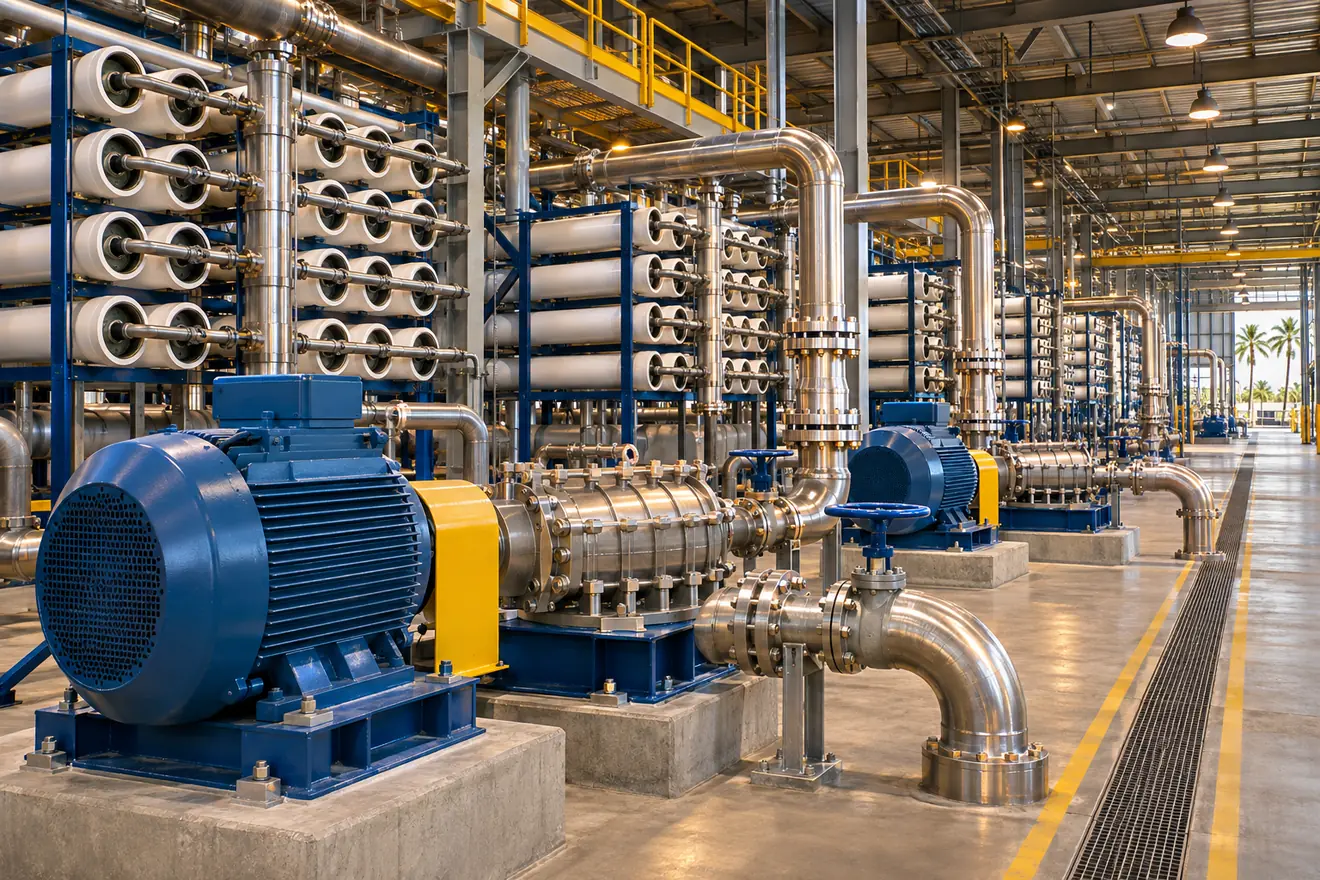
Florida has dozens of desalination plants, and most of them use reverse osmosis to treat brackish groundwater rather than seawater. The South Florida Water Management District counted 41 brackish and two seawater plants in its region in 2024, able to produce 296 million gallons of drinking water a day. The best-known seawater plant is the Tampa Bay Seawater Desalination Plant (up to 25 million gallons a day); in the Keys, seawater plants exist but serve mainly as an emergency backup.
Alternative water supplies are the sources Florida turns to beyond fresh groundwater: desalinated brackish water and seawater, reclaimed water, stormwater, surface water captured in wet weather, and water held in new storage such as reservoirs or aquifer storage and recovery wells. They cost more to develop than traditional wells, but they spread risk, so a utility with several sources is less exposed when a drought hits one of them. Reclaimed water already supplies more than a billion gallons a day statewide, and South Florida's desalination plants alone can produce 296 million gallons a day.
What counts as an alternative supply
Section 373.019(1) of the Florida Statutes defines alternative water supplies as salt water; brackish surface and groundwater; surface water captured predominately during wet-weather flows; sources made available by adding new storage capacity for surface or groundwater; water reclaimed after public supply, municipal, industrial, commercial or agricultural use; the downstream augmentation of water bodies with reclaimed water; stormwater; and any other source a regional water supply plan designates as nontraditional.
The reason is supply limits. According to FDEP's alternative water supply page, groundwater withdrawals are expected to level off as the source reaches its sustainable limit, while water demand is projected to grow 13% between 2020 and 2040, to 7,302 million gallons per day. Meeting all of that from groundwater in large areas would cause saltwater intrusion, reduced spring flows, lowered lake levels and loss of wetlands. FDEP also notes that alternative supplies are frequently more expensive to develop and operate. The background is in where Florida's water comes from.
Desalination: brackish and seawater
Desalination removes dissolved salts. FDEP says reverse osmosis is the most common method in Florida: pressure forces salty water through a semi-permeable membrane that holds the salt back and lets fresh water through. What stays behind is a concentrated brine that must be managed safely, which is a major design and permitting issue for every plant.
Brackish groundwater is the workhorse. USGS notes that in south Florida the Upper Floridan aquifer is brackish and is used as source water for reverse osmosis. The South Florida Water Management District reports that, as of 2024, South Florida had 41 brackish and two seawater desalination plants operating, with capacity to produce 296 million gallons of potable water per day; with help from the district's Alternative Water Supply program, the number of plants grew 95 percent since 2005 and their capacity 146 percent. The district adds that seawater desalination is still significantly more expensive than treating brackish groundwater, although costs have come down. Seawater holds far more salt, so it takes more pressure and energy to treat.
How many desalination plants are in Florida?
No single statewide count appeared in the state and district pages used for this guide, so treat any one figure with care. The most recent hard number is regional: 43 plants (41 brackish, 2 seawater) in the South Florida Water Management District as of 2024. Other districts, including the Southwest Florida Water Management District where Tampa sits, add more plants, and the total shifts as utilities build and retire them. Your utility's water quality report or the relevant water management district is the best place to check a specific area.
Tampa desalination plant: the Tampa Bay seawater plant
The Tampa Bay Seawater Desalination Plant, online since 2007, provides up to 25 million gallons per day of drinking water, which Tampa Bay Water says can supply up to 10 percent of the region's needs. It takes in up to 44 million gallons per day of warm seawater from the cooling water of Tampa Electric's Big Bend power station. At full capacity, about 19 million gallons per day of concentrate, roughly twice as salty as seawater, goes back into that cooling water stream and is diluted up to 70-to-1. The utility reports that monitoring has shown no measurable salinity changes in Tampa Bay related to plant production. The Southwest Florida Water Management District contributed $85 million toward eligible capital costs.
Tampa Bay Water owns the plant and a private partnership, U.S. Water-Acciona Seawater Desalination Partners, operates it. Its output is blended with water from the utility's other sources and delivered to Hillsborough, Pasco and Pinellas counties, New Port Richey, St. Petersburg and Tampa. The utility calls it a drought-proof alternative supply. It is the exception rather than the rule: a seawater plant sited next to a power station that supplies both the source water and the electricity.
Florida Keys desalination plants
The Keys do not rely on desalination day to day. According to the Florida Keys Aqueduct Authority (FKAA), most of the water is fresh groundwater from the Biscayne Aquifer, pumped from a wellfield west of Florida City on the mainland and treated at the J. Robert Dean Water Treatment Facility. It travels through a 130-mile transmission main to the Keys. FKAA reports that it delivers approximately 17 million gallons per day to Keys residents.
Desalination fills two supporting roles. Brackish water from the deeper Floridan aquifer, which FKAA says holds roughly 4,000 to 5,000 parts per million of salt, is treated by low-pressure reverse osmosis and blended with the Biscayne water. Separately, FKAA's seawater reverse osmosis plants, the Kermit H. Lewin plant on Stock Island and a plant in Marathon, are described as emergency sources for additional water. FKAA also lists a Crawl Key reverse osmosis facility among its Middle Keys projects.
Aquifer storage and recovery
FDEP describes aquifer storage and recovery (ASR) as injecting potable water into an aquifer, storing it and recovering it as needed. In south Florida the brackish Upper Floridan aquifer is used for this. Success depends on local geology and chemistry, because stored water mixes with native groundwater and reacts with the rock, so recovered water has to be checked and sometimes treated again.
Reservoirs and stored surface water
Tampa Bay Water stores surface water in the 15.5-billion-gallon C.W. Bill Young Regional Reservoir during wet periods and withdraws it for treatment during dry ones. Storage helps only if there is water to store: during the 2025-2026 drought, SWFWMD reported the reservoir held 7.87 billion gallons on Sept. 20, 2026, about half its capacity.
Reuse and stormwater as supply
Reclaimed water is the largest alternative supply most homeowners see. FDEP's 2025 Reuse Inventory, published in August 2026, reports about 1,029 million gallons per day reused in 2025 and estimates that reuse offset about 175.5 billion gallons a year of potable-quality water, much of it by taking over landscape irrigation. Reclaimed irrigation water is not drinking water; the guide on whether reclaimed water is safe explains what it is and is not suited for. Potable reuse, which turns advanced treated wastewater into a drinking water source, became possible to permit under Chapter 62-565, effective Feb. 26, 2025; see the guide to potable reuse rules and the explainer on what reclaimed water is. If you want to know whether it reaches your street, see getting reclaimed water service.
Stormwater is a local, rain-driven supply. Neighborhood ponds and cisterns can capture it for irrigation, but its quality depends on what it washed off, and collection alone does not make it drinkable. The small-scale version is covered in the guide to rain barrels and stormwater ponds.
Comparing the options
General tendencies, not costs for any particular project:
| Option | Relative cost | Energy use | Drought resilience | Main challenge |
|---|---|---|---|---|
| Brackish desalination | Moderate; below seawater | Moderate to high | High; does not depend on recent rain | Concentrate disposal, aquifer limits |
| Seawater desalination | Highest | High | Very high; the sea does not run dry | Energy, intake and concentrate management |
| Aquifer storage and recovery | Varies by site | Pumping in and out | Good while stored water lasts | Geology and recovered water quality |
| Reservoirs | High to build | Pumping and treatment | Good for one dry season, weaker in multi-year drought | Refilling during drought |
| Reclaimed water (non-potable) | Moderate | Treatment and pumping | High; wastewater keeps flowing | Separate pipe network; supply peaks do not match irrigation peaks |
| Stormwater capture | Low to moderate | Low | Low without storage | Variable rain and water quality |
Why diversification matters in a drought
FDEP describes source diversification as a tool for drought resilience and reliability: a system that draws on several sources is more reliable than one that relies on a single source. A wellfield, a river intake, a reservoir and a desalination plant respond to dry weather differently, and conservation eases pressure on all of them. Check your utility and water management district for current plans and shortage conditions.
Frequently Asked Questions
How many desalination plants are in Florida?
There is no single official statewide figure in the sources used here. The South Florida Water Management District counted 43 plants in its region in 2024, 41 brackish and two seawater, with 296 million gallons per day of capacity. Plants elsewhere in the state come on top of that.
Is there a desalination plant in the Florida Keys?
Yes. FKAA operates seawater reverse osmosis plants, including the Kermit H. Lewin plant on Stock Island and one in Marathon, as emergency sources. Day to day the Keys get mostly Biscayne Aquifer water piped from Florida City, plus brackish Floridan aquifer water treated by reverse osmosis.
Where is the Tampa desalination plant?
It sits next to Tampa Electric's Big Bend Power Station and draws warm seawater from the plant's cooling water. It has been online since 2007 and can produce up to 25 million gallons per day for the Tampa Bay Water region.
Does Florida turn seawater into drinking water?
Yes, at a few plants. The Tampa Bay Seawater Desalination Plant can produce up to 25 million gallons per day, and SFWMD counted two seawater plants in South Florida in 2024. Most Florida desalination, though, treats brackish groundwater, which is cheaper to process.
What happens to the salt removed by desalination?
It leaves the plant in a concentrated brine that has to be managed safely. At the Tampa Bay plant, about 19 million gallons per day of concentrate at full capacity is diluted up to 70-to-1 in a power station's cooling water before discharge.
Is aquifer storage and recovery a new water source?
No. ASR stores water underground in wet periods and pumps it back out when needed. It adds storage, not new water.
Does using reclaimed water help drinking water supplies?
Yes, indirectly. FDEP estimates that reuse offset about 175.5 billion gallons a year of potable-quality water in 2025, much of it by replacing drinking water used for irrigation. Reclaimed irrigation water itself is not drinking water.