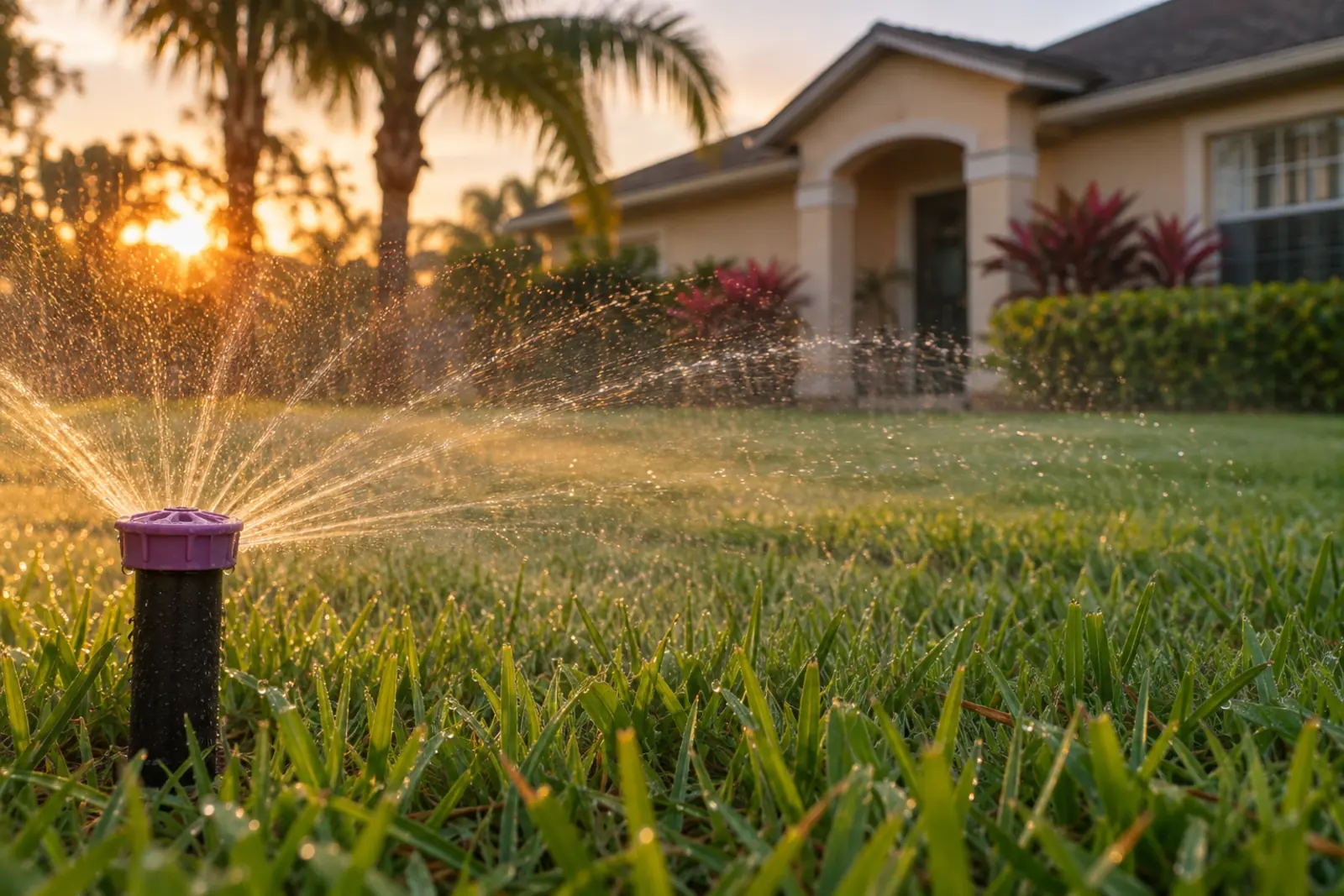
Reclaimed water for irrigation in Florida is used the way you would use drinking water on a lawn: only when the grass shows it needs it, about 1/2 to 3/4 inch at a time, early in the morning, and only on the days and hours your utility and local rules allow. Reclaimed water is often exempt from water management district schedules, but utilities and local governments can and do restrict it. Its salts and nutrients also mean you may need less fertilizer and more care with sensitive plants.
Why reclaimed water comes with a schedule
Reclaimed supply depends on how much wastewater a plant treats, how much it can store and a separate pipe network. When thousands of sprinklers run on a dry evening, demand outruns supply and pressure drops. Schedules spread that demand out.
Orange County Utilities' customer guide (revised 2017), for example, tells customers to design irrigation systems for reclaimed water pressure between 40 and 60 pounds per square inch and warns that pressure varies with demand and time of day; it also says the supply "is not unlimited and should not be wasted or overused." Pinellas County Utilities limits reclaimed lawn watering to three days a week during the dry season because shortages have stressed its distribution system. These are local rules, so check your own utility's schedule. For how the water is produced, see what reclaimed water is.
Is reclaimed water for irrigation in Florida exempt from watering restrictions?
Often partly, never automatically. District year-round rules frequently exempt reclaimed water from the day-of-week schedule, but your utility, city or county can set its own days and hours, and a water shortage order can change the picture again.
Three layers can apply at once: the district's year-round rule, any water shortage order, and city, county or utility rules. An exemption from one layer is not an exemption from the others.
| District | Year-round rule and reclaimed water | What else to check |
|---|---|---|
| Southwest Florida (Rule 40D-22.201) | Reclaimed irrigation is not limited by the day schedule; the 10 a.m. to 4 p.m. ban is voluntary for reclaimed water | Local government and reclaimed provider restrictions; the current shortage order |
| South Florida (Chapter 40E-24) | Reclaimed water is listed among the exemptions from the year-round landscape irrigation rule | Utility schedules and local ordinances |
| St. Johns River (Rule 40C-2.042) | Irrigation from a reclaimed water system "is allowed anytime" under the year-round rule | Current shortage orders and utility schedules |
Shortage orders deserve their own check. SWFWMD's Modified Phase III "Extreme" restrictions, extended through March 31, 2027, cover 11 west-central Florida counties in full and parts of four others; under them, using only reclaimed water "is only subject to voluntary watering hours, unless restricted by the local government or utility," according to the district's restrictions page. In northeast and central Florida, SJRWMD declared a Phase III Extreme Water Shortage on May 11, 2026, limiting landscape irrigation to one day a week. Shortage orders can be broader than the year-round rule, so read the current order for your county.
Irrigation wells are a related point. Under SJRWMD's rule, a private well may not be used for landscape irrigation where reclaimed water is available, and some utilities require existing wells to be disconnected from the irrigation system or fitted with an approved backflow device. The guide to Florida lawn watering restrictions explains how the layers fit together, and the overview of Florida's water management districts shows which district covers your county. Confirm your days and hours with your utility or water management district before setting a controller.
How much and how often to water
UF/IFAS's publication Watering Your Florida Lawn recommends watering "as needed." Florida's sandy soils typically hold about 1 inch of water in the top 12 inches, so 1/2 to 3/4 inch wets the root zone of a lawn whose roots are in that layer. Watch for these signs of drought stress before you water:
- Leaf blades folding in half lengthwise.
- A blue-gray tint instead of green.
- Footprints or tire tracks that stay visible long after you walk across the grass.
To learn how long each zone takes, set straight-sided cans in a line across the zone, run it for 15 minutes and measure. If the cans hold 1/4 inch, the zone needs 30 to 45 minutes. Uneven amounts point to a head that needs fixing, not a longer runtime.
Early morning is the best time to water. Skip irrigation if about 1/2 to 3/4 inch of rain fell the day before; most of Florida averages 50 inches or more of rain a year. Light, frequent watering encourages shallow roots, and overwatering raises disease and thatch problems and favors weeds such as dollarweed and sedges.
Salts, sensitive plants and nutrients
UF/IFAS's 2023 publication on reclaimed water in edible landscapes explains that salts can damage leaves and reduce the water available to roots, and that plants differ widely in salt tolerance. If a shrub or bed declines, look at water quality alongside coverage, drainage and plant choice rather than simply watering more. Keep spray off foliage where you can, and zone lawns and planting beds separately.
Smell and salt content are the two most common worries; the guide on whether reclaimed water is safe, with myths and facts on smell and salts covers them. Reclaimed water also carries nitrogen and phosphorus, and levels vary by source, so ask your provider for typical values. UF/IFAS's 2024 publication on stormwater wet ponds goes further: it advises people who irrigate with reclaimed water to use less fertilizer or consider stopping entirely, because the water already contains the same nutrients, and it names reclaimed irrigation as one contributor to nutrient buildup in neighborhood ponds. Always follow local fertilizer ordinances. Food plants need extra caution, covered in the guide to reclaimed water and vegetable gardens.
Sprinkler heads and irrigation equipment on reclaimed water
A reclaimed irrigation system is an ordinary sprinkler system running on a separate supply, so the same heads, nozzles and controller logic apply. What changes is the supply: pressure that rises and falls with neighborhood demand, and water that carries salts and nutrients. Ask your provider whether it has equipment requirements before you buy or replace parts.
- Match the system to the pressure. As noted above, Orange County Utilities advises designing for 40 to 60 psi and warns that pressure varies by time of day. Heads that need more than the line delivers will mist or fall short, which looks like a dry spot and tempts people to add runtime.
- Inspect heads and nozzles routinely. Look for clogged, tilted, sunken or broken heads, and clear or replace them instead of lengthening the zone. The catch-can test described above shows which zones are uneven.
- Keep spray off hard surfaces and foliage you do not want wet. Overspray wastes water, and salts left on leaves can damage salt-sensitive plants.
- Do not mix supplies. Reclaimed irrigation lines must stay separate from drinking water plumbing, and outlets should stay labeled. See the guide to purple pipes and cross-connections.
System habits that prevent waste
| Do | Don't |
|---|---|
| Aim heads at the lawn and beds | Spray roads, driveways, sidewalks, pools, spas or neighbors' property |
| Stop and investigate puddles or runoff | Keep watering saturated ground or water during a rainstorm |
| Keep the rain or soil moisture sensor working | Let the controller run after a soaking rain |
| Reset the controller as seasons change | Leave a summer schedule running all winter |
| Fix broken and clogged heads | Lengthen every zone to hide one dry spot |
| Keep reclaimed outlets labeled | Drink from them or connect them to household plumbing |
Florida law (section 373.62, Florida Statutes) requires anyone who installs an automatic landscape irrigation system to install, maintain and operate technology that shuts it off when there is enough moisture, such as a rain or soil moisture sensor. Contact your utility about persistent low pressure, supply outages or any suspected connection between reclaimed and drinking water lines. More ways to trim outdoor use are in the guide to saving water at home.
Frequently Asked Questions
Can I water every day with reclaimed water?
Usually not. A district exemption does not override utility or local schedules, and many utilities set reclaimed watering days. Even where daily watering is allowed, UF/IFAS advises watering only when the lawn shows signs of stress.
Why is my reclaimed water pressure low?
Pressure varies with how many customers are irrigating and the time of day, and it often drops in dry weather when demand peaks. Check your system for broken heads and leaks, and report persistent low pressure to your utility.
Do I still need fertilizer if I use reclaimed water?
Often less. Reclaimed water contains nitrogen and phosphorus, and UF/IFAS suggests reducing or even stopping fertilizer for reclaimed-irrigated landscapes. Ask your provider for nutrient levels and follow local fertilizer ordinances.
Do I need special sprinkler heads for reclaimed water?
Requirements differ by utility, so ask your provider. In practice the priorities are pressure within the range the system was designed for, working and well-aimed heads, and separation from drinking water lines.
How do I get reclaimed water for my yard?
Only where a utility runs a reclaimed network to your street, and connection terms vary by provider. The guide to getting reclaimed water service, availability, cost and connection explains how to check.
Can reclaimed water hurt landscape plants?
It can harm salt-sensitive plants, because salts can damage leaves and reduce the water roots can use. Most turf and many ornamentals handle it well. If plants decline, review plant choice, coverage and drainage, and ask your utility about water quality.