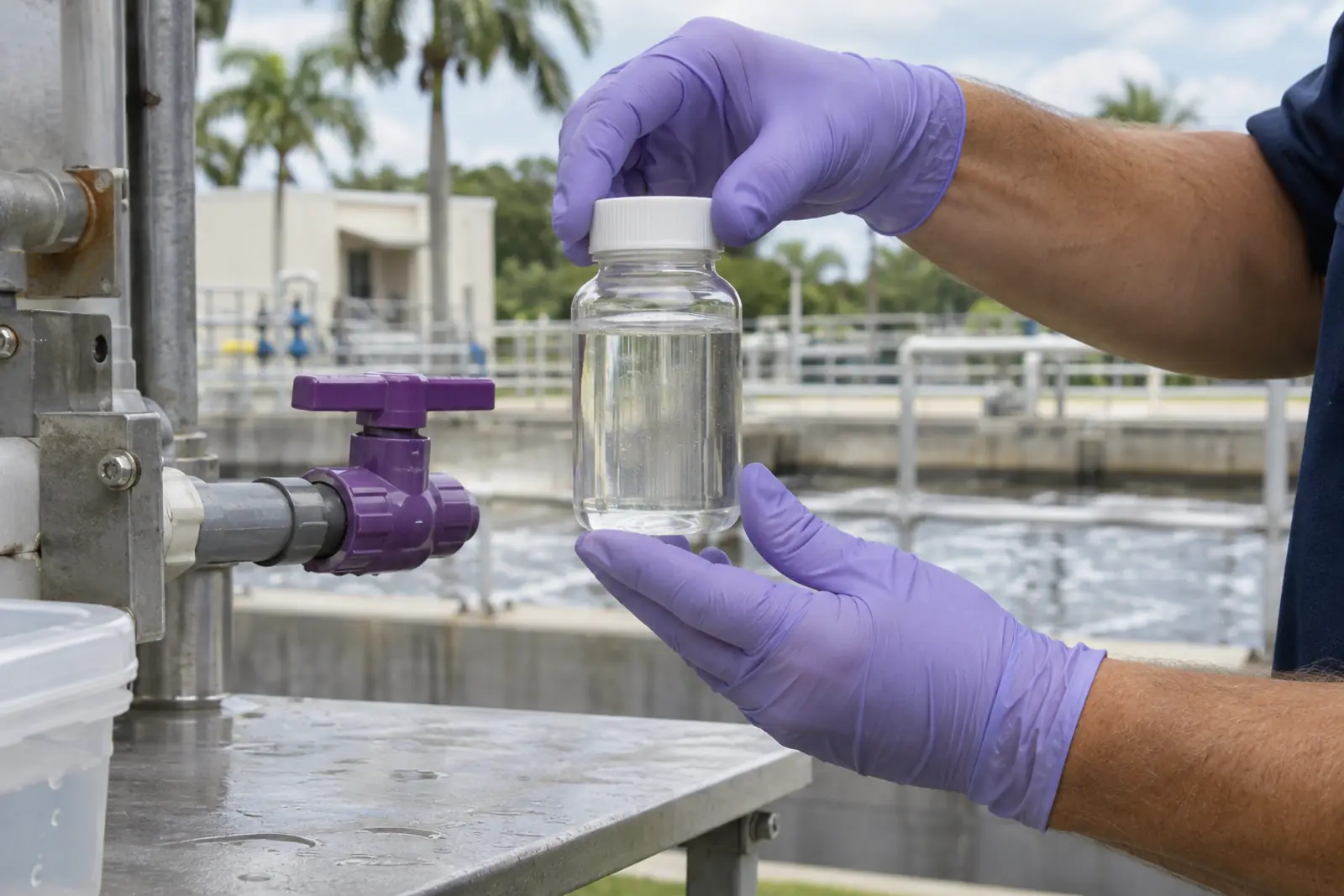
Reclaimed water is safe for what it is made for: irrigating lawns, landscapes and similar non-drinking uses. It is not safe to drink, to swim in, or to fill a pool with, and it must never be connected to household plumbing. Most myths mix it up with either raw sewage or drinking water, and it is neither: it is wastewater that has been treated, filtered and disinfected to a standard set for irrigation. If it ever looks, smells or behaves differently than usual, report it to your utility.
Quick answers: myths and facts
| Myth | Fact |
|---|---|
| "It's just sewage." | It starts as wastewater, but water for lawns and parks must receive secondary treatment, filtration and high-level disinfection under Florida rules |
| "It's clear, so it's safe to drink." | Appearance proves nothing; reclaimed water still contains salts, nutrients and pathogens and is never for drinking |
| "Touching it is dangerous." | Normal irrigation contact is not the concern; drinking it, playing in the spray or using it for washing is. Wash hands with tap water after contact |
| "It always smells." | Properly treated reclaimed water is usually clear and odorless; a new odor or color is worth reporting |
| "It will kill my plants." | Most lawns and many ornamentals do well; salt-sensitive plants can suffer |
| "It's unlimited and free." | Supply can run short in dry seasons, and many utilities charge for it, often less than for drinking water |
| "Purple pipes carry potable reuse water." | No. Potable reuse is a separate, permitted process with advanced treatment under a different state rule |
Is reclaimed water safe? What "safe" means here
Safety depends on the use, not on the water alone. The U.S. EPA's water reuse overview explains that required treatment scales with the likelihood of human exposure, and that states set their own treatment and use rules. In Florida, irrigation-grade reclaimed water is treated for exactly that purpose: watering plants. Drinking it, bathing in it or piping it into a house falls outside what it was treated for.
In practice, reclaimed water is safe when it stays in the irrigation system, comes out of sprinklers or drip lines onto plants, and nobody drinks it or plays in it. The sections below take the common "is it safe to...?" questions one at a time.
Where the water comes from and what treatment does
Reclaimed water begins as household and business wastewater. Before it reaches a yard, Rule 62-610.460 requires at least secondary treatment, filtration and high-level disinfection, with suspended solids no higher than 5.0 mg/L before disinfection. Under Rule 62-600.440, high-level disinfection means that over 30 days, 75% of fecal coliform samples must be below detection and no single sample may exceed 25 per 100 mL.
Those numeric limits target particles and fecal bacteria, the indicators used to control pathogens. They were not written to measure every trace chemical, and fecal coliform is an indicator, not a test for every possible germ. That is why the rules pair treatment with use limits: no drinking, no pools, no direct spray on produce eaten raw. For the full picture of the process, see the guide to what reclaimed water is and how Florida treats it.
Smell, color and appearance
UF/IFAS, in its 2023 publication Reclaimed Water in Your Florida-Friendly Edible Landscape, describes treated reclaimed water as clean, clear and usually odorless. Orange County Utilities' customer guide describes its own reclaimed water as clear, nonstaining and odorless and says it is monitored 24 hours a day. Looks can deceive in both directions, though: FDEP's cross-connection page notes that it is "virtually impossible to distinguish reclaimed water from drinking water by sight and scent." Never taste water to find out which it is.
Because the senses cannot tell the two apart, Florida relies on markings instead. According to FDEP, non-metal, non-concrete reclaimed water pipe must be Pantone Purple 522C, and reclaimed water valves and outlets must carry a "Do not drink" label in English and Spanish with the international symbol. A purple pipe or a "Do not drink" tag is the signal to treat the water as non-drinking; see purple pipes and cross-connections for what to look for at home.
Is reclaimed water safe to touch?
Brief, incidental contact during normal irrigation is not what utilities warn about. UF/IFAS states that reclaimed water still contains pathogens and must never be used for drinking or sanitary purposes, and advises washing hands with potable water after contact. Orange County's guide says there is no known danger from contact when reclaimed water is used for its intended purpose. The concern is activities that lead to swallowing or soaking, so wash hands with tap water after handling hoses or sprinkler heads and before eating.
Is reclaimed water safe to swim in?
No. Reclaimed water is not meant for swimming or for filling anything people swim in. Florida's Rule 62-610.469 forbids filling swimming pools, hot tubs or wading pools with it anywhere in the state, and utilities draw the same line for water play: Seminole County Utilities, for example, prohibits playing in sprinklers, washing pets or vehicles, and filling pools. Swimming means swallowing some water, and treated reclaimed water still contains some pathogens. Fill pools, kiddie pools and water toys from the drinking water supply, and keep children and pets out of reclaimed sprinkler spray.
Is reclaimed water safe for gardens?
For lawns, shrubs, trees and most ornamentals, yes. This is the main use it is built for, and many yards do well on it. Edible gardens are a stricter case. Reclaimed water contains pathogens, salts and nutrients, so what is allowed on food crops depends on state rules and on your utility's own use conditions, which vary. Wash all produce with tap water, and check with your utility before using reclaimed water on a vegetable bed. The guide on using reclaimed water on a vegetable garden covers what to ask.
Salts and nutrients
Reclaimed water carries dissolved salts. UF/IFAS says salt levels above 1,000 parts per million are too high for most crops and that sensitivity varies widely, but a struggling shrub may be reacting to overwatering, poor drainage or a poor plant choice instead. Ask your utility for water quality data before blaming the water.
Reclaimed water also contains nitrogen and phosphorus. That can reduce fertilizer needs, but it does not make the water a complete fertilizer, and levels vary by source. More water is not better for plants just because it is cheaper; see the guide to watering with reclaimed water.
The PFAS question
PFAS are a large family of long-lasting synthetic chemicals used in many consumer and industrial products, so they can be present in household wastewater. Whether they occur in a particular utility's reclaimed water, and at what levels, is a question for that utility. The irrigation reuse standards described above were built around solids and fecal indicators, so meeting them does not show that PFAS are absent.
The clearest state requirement appears in the potable reuse rule. Chapter 62-565, effective Feb. 26, 2025, requires Advanced Treatment Water Facilities to remove at least 12 logs of Giardia and Cryptosporidium and 14 logs of enteric viruses, and to monitor six PFAS compounds (PFOA, PFOS, PFHxS, PFNA, HFPO-DA and PFBS) every quarter. That applies to drinking water projects, not to purple-pipe irrigation water. Research on PFAS in reuse is ongoing. Meanwhile, the habits that limit pathogen exposure also limit chemical exposure: do not drink reclaimed water, do not spray it on produce eaten raw, and wash hands and produce with tap water.
Supply, cost and potable reuse confusion
Reclaimed water is not an endless supply. Orange County's guide says plainly that it "is not unlimited," and Pinellas County Utilities limits reclaimed lawn watering to three days a week in the dry season because shortages have stressed its system. It is often cheaper than drinking water, but not necessarily free: Hillsborough County's rates effective Oct. 1, 2026, for example, charge single-family reclaimed customers a $6.96 base facility charge plus $0.43 to $0.99 per 1,000 gallons, compared with $1.21 to $8.35 per 1,000 gallons for drinking water. Rates vary widely; the guide to reclaimed water service and cost explains what to ask. Purple-pipe water and potable reuse share a starting point but end up as very different products, covered in the guide to potable reuse rules.
What to report to your utility
- Reclaimed water with an unusual odor, color or cloudiness.
- Low pressure, broken sprinklers, leaks or water running into the street.
- Any suspected connection between reclaimed and drinking water plumbing.
- Tap water that suddenly tastes, smells or looks odd; stop drinking it until the utility checks.
Note the location, when it started and whether it happens only during irrigation, and use the contact options on your utility's website.
Frequently Asked Questions
Can reclaimed water make someone sick?
It can if it is swallowed, because treated reclaimed water still contains some pathogens. Do not drink it, play in it or use it for washing, and wash your hands with tap water after contact. Used for irrigation as intended, contact is not considered a known danger by utilities such as Orange County.
Is reclaimed water safe to swim in?
No. Florida's Rule 62-610.469 forbids filling swimming pools, hot tubs or wading pools with reclaimed water, and utilities such as Seminole County prohibit playing in the sprinklers. Use drinking water for pools and water play.
Is reclaimed water safe for gardens?
It is widely used on lawns and landscape plants. For vegetables and other food plants, rules and utility conditions vary, so check with your utility first, avoid spraying produce eaten raw and wash everything with tap water.
Why does my reclaimed water smell?
Properly treated reclaimed water is usually odorless, so a noticeable smell is worth reporting to the utility. Odor alone cannot tell you the cause. Do not try to diagnose it by tasting the water.
Can children play in reclaimed water sprinklers?
They should not. Water play leads to swallowing water, and some utilities, such as Seminole County Utilities, expressly prohibit playing in reclaimed sprinklers. Use the drinking water supply for any water play.
Does reclaimed water contain PFAS?
It can, because PFAS are common in consumer products and household wastewater, but levels depend on the source, so ask your utility. Florida's 2025 potable reuse rule requires quarterly PFAS monitoring at advanced treatment facilities; irrigation standards focus on solids and fecal bacteria.