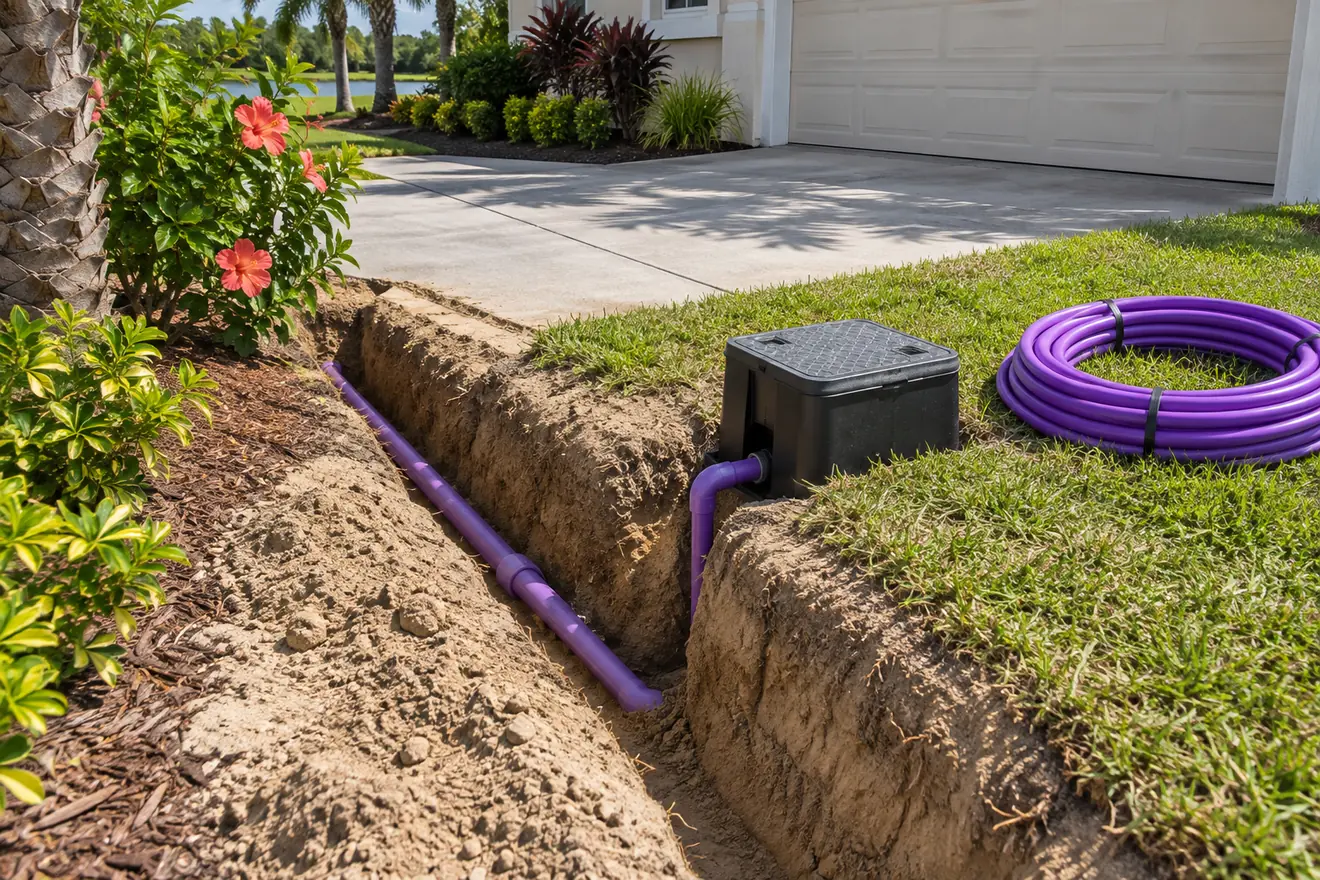
Reclaimed water is generally not free: Florida utilities charge for it, but often less per gallon than drinking water. Depending on the utility, you pay a flat monthly charge or a metered rate per 1,000 gallons, and some add a one-time connection fee. To get it, first ask the utility that serves your address whether reclaimed lines reach your lot. If service is available, expect an application, a licensed contractor to tie your sprinkler system to the reclaimed line and cut it off from drinking water, a backflow device on your drinking water meter and an inspection before service starts. Availability, prices and rules differ from one utility to the next.
How much does reclaimed water cost?
Utilities use two basic structures. Unmetered service is a flat monthly charge, sometimes scaled by lot size. Metered service charges for measured gallons, often in tiers, on top of a base charge or minimum bill. Taxes and outside-city surcharges can apply, and so can a one-time connection or tap fee. Two published examples, current as of November 2026:
| Utility (rates effective Oct. 1, 2026) | Reclaimed water | Drinking water, for comparison |
|---|---|---|
| City of St. Petersburg | Unmetered: $46.36 a month for one acre or less, plus $26.57 per additional acre. Metered: $1.28 per 1,000 gallons, $46.36 minimum. Plus 10% tax inside city limits; 25% surcharge outside, except as approved by City Council. Not available in all areas | Single-family volume charges of $4.68 to $26.73 per 1,000 gallons in four tiers, plus a base charge |
| Hillsborough County Water Resources | Single-family metered: $6.96 base facility charge, plus $0.43 (0-5,000 gallons), $0.72 (5,001-15,000) and $0.99 (above 15,000) per 1,000 gallons per ERC | $14.67 base facility charge, plus $1.21 to $8.35 per 1,000 gallons in four tiers |
These examples show structures, not what you will pay: a flat charge can cost more than metered drinking water for a small yard and far less for a large one. Compare whole bills and confirm current rates with your utility; both examples changed on Oct. 1, 2026.
The cost of reclaimed water has three parts to compare: the one-time cost of getting connected (utility fees, plus the contractor who separates and connects your sprinklers), the monthly charge, and the backflow device on your drinking water meter, which the utility may require you to maintain and have tested. Ask for all three before deciding.
Is reclaimed water available at your address?
Start with the city, county or private utility that provides your drinking water and ask whether it, or another provider, supplies reclaimed water on your street; many utilities post service maps or let you check an address online. A main in the neighborhood does not guarantee your lot can connect; Hillsborough County, for example, said in a 2024 news release that reclaimed service is available on a case-by-case basis. Subdivision signs, purple valve-box lids and neighbors' utility bills are clues that service exists nearby, but only the utility can confirm your lot. The purple pipes and cross-connections guide covers how to recognize reclaimed equipment at your own property.
Also ask whether connecting is optional. Orange County Utilities' customer guide (revised 2017) says the county prohibits using drinking water for irrigation where reclaimed service is available, and new developments near its system must use reclaimed water if their approvals require it. In the St. Johns River district, a private well may not be used for landscape irrigation once reclaimed water is available through a utility connection point. Which district covers you is explained in the guide to Florida water management districts.
What connecting usually involves
- Apply for service. Confirm eligibility, any connection or tap fee, and which parts of the work the utility does.
- Utility installs the service. In many systems the utility brings the reclaimed service line or meter to the property; ask where its responsibility ends and yours begins.
- Connect the sprinklers. A licensed plumber or irrigation contractor connects the irrigation system to the reclaimed service and permanently separates it from drinking water plumbing. A valve that switches between the two supplies is not a substitute for that separation.
- Backflow protection. Florida's Rule 62-555.360 requires at least a dual check device on a home's drinking water connection where reclaimed water is present, refurbished or replaced at least every 5 to 10 years; some utilities require more.
- Inspection. Under Rule 62-610.469, the utility must inspect new connections and recheck them periodically. FDEP's 2025 Reuse Inventory, published in August 2026, counted 33,447 new public-access connections in the 2025 reporting year, 96.7% of them inspected for cross-connections.
Orange County, for example, requires an approved backflow device next to the drinking water meter before service begins and tests it periodically.
Irrigation wells and existing sprinkler systems
Tell the utility about every irrigation source, including a private well. Orange County requires existing irrigation wells to be permanently disconnected from the irrigation system or fitted with a county-approved double check backflow device, plus a reduced pressure backflow device on drinking water connections when a well is on the property.
An existing sprinkler system can often be reused. Orange County accepts standard white PVC pipe in existing systems, requires in-ground sprinklers for reclaimed irrigation and does not allow hoses or spigots on residential reclaimed lines; Rule 62-610.469 generally bars above-ground hose bibs on reclaimed systems. Have the contractor check heads, leaks and coverage; Orange County recommends designing for 40 to 60 psi. After connecting, set the controller to the watering schedule that applies to you.
HOAs, condos and common areas
In shared systems, find out who owns the lines, who holds the account, who pays and who approves repairs, and read the governing documents before arranging an individual hookup. Common areas and private lots may be on different arrangements. Boards should coordinate watering days across common areas and think about runoff: UF/IFAS's 2024 publication on stormwater wet ponds notes that nutrients in reclaimed irrigation water contribute to nutrient buildup in neighborhood ponds and advises using less fertilizer or stopping it entirely.
Pros and cons
| Pros | Cons |
|---|---|
| Saves drinking water for drinking | Not available on every street |
| Often cheaper per gallon than drinking water | Flat or base charges apply even in rainy months |
| Contains nutrients that can cut fertilizer use | Salts can stress sensitive plants |
| Can be exempt from some district watering schedules | Utilities may set their own days, and dry-season supply can run short |
| Uses an existing irrigation system in many cases | Requires backflow protection, inspections and strict separation from household plumbing |
Plant and fertilizer questions are covered in watering with reclaimed water. For questions about smell, salts and safety, see reclaimed water myths and facts; for edible plants, see the page on reclaimed water on vegetable gardens. If you are new to the topic, what reclaimed water is and how Florida treats it explains the basics.
Questions to ask your utility
- Is reclaimed water available at this address, and is connecting required?
- Is service metered or flat-rate, and what are the connection fee, monthly charges, taxes and surcharges?
- Which parts of the installation does the utility do, and which need a contractor?
- What backflow device is required, and who tests and maintains it?
- What must happen to an existing irrigation well?
- Which days and hours may reclaimed customers water, and do dry-season limits apply?
Frequently Asked Questions
Do you pay for reclaimed water?
Yes. Utilities bill for reclaimed water, either as a flat monthly charge or by metered volume. In November 2026, St. Petersburg listed unmetered service at $46.36 a month for one acre or less, while Hillsborough County charged $0.43 to $0.99 per 1,000 gallons for single-family metered service, plus a $6.96 base facility charge.
How do I get reclaimed water at my house?
Ask the utility serving your address whether reclaimed lines reach your lot, then apply for service. A licensed contractor must connect your sprinklers to the reclaimed line and separate them from drinking water plumbing, and the utility inspects the connection before service starts.
How do I find out if reclaimed water is near me?
Check your utility's website for a service map or address lookup, or call the utility. Neighborhood signs and purple valve boxes suggest reclaimed lines are close, but a main on the street does not guarantee your lot can connect.
Does a purple valve-box lid mean I can get reclaimed water?
Not necessarily. It shows reclaimed equipment is nearby, but only the utility can confirm whether your lot can connect and at what cost.
Is reclaimed water cheaper than drinking water?
Per gallon it often is: in November 2026, Hillsborough County charged $0.43 to $0.99 per 1,000 gallons for single-family reclaimed water versus $1.21 to $8.35 for drinking water. Flat charges, base fees and connection costs can change the math for small yards, so compare whole bills.
Can my existing sprinkler system use reclaimed water?
Often, yes, after inspection and any required changes. It must be completely disconnected from drinking water plumbing, and the drinking water meter needs backflow protection.
Can I keep my irrigation well?
It depends on the utility and district. In the St. Johns River district, a well may not be used for landscape irrigation once reclaimed water is available, and Orange County requires wells to be disconnected or fitted with backflow devices. Tell the utility about the well before connecting.