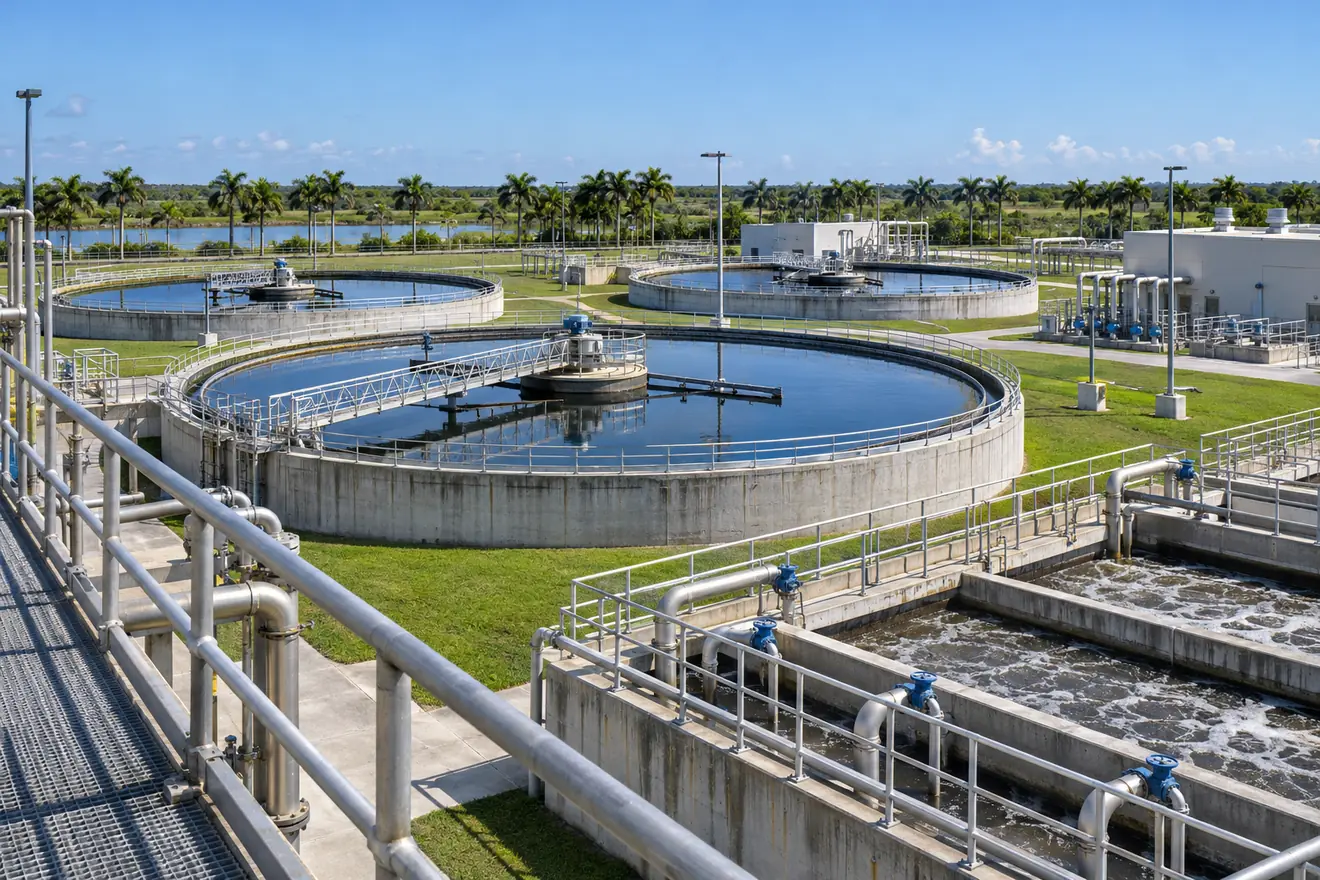
Reclaimed water is domestic wastewater that has been treated at a wastewater plant and then put to a planned, beneficial use instead of being discharged. In Florida it waters home lawns, golf courses, parks and school grounds, cools industrial equipment, recharges groundwater and feeds wetlands. Water delivered for yards and parks must receive secondary treatment, filtration and high-level disinfection, but it is still not drinking water.
Reclaimed water meaning: what the term covers
"Reclaimed water" is the term Florida agencies use for treated domestic wastewater that is reused. The U.S. EPA describes the same idea as water reuse, also called water recycling or water reclamation: treating wastewater and putting it to another use. So "reclaimed water", "recycled water" and "reuse water" usually point to the same thing. What differs from place to place is the treatment level, which is matched to how likely people are to come into contact with the water.
Reclaimed water is not the same as rainwater collected from a roof, which is covered in the guide to rain barrels, cisterns and stormwater reuse, and it is not tap water that was simply used twice at home.
How wastewater becomes reclaimed water
Wastewater treatment removes solids, breaks down organic material and reduces disease-causing organisms. Each stage helps the next: removing solids helps biological treatment, and removing fine particles helps disinfection. The basic sequence:
| Step | What happens | What it removes or reduces |
|---|---|---|
| Primary treatment | Solids settle and floating material is skimmed off | Settleable solids, grease and floating debris |
| Secondary treatment | Microorganisms consume organic material and are then separated from the water | Biodegradable organic matter and more suspended solids |
| Filtration | Water passes through a filter, often after chemicals help fine particles clump together | Fine particles and some microorganisms |
| High-level disinfection | A disinfection process treats the filtered water | Disease-causing microorganisms |
Primary treatment alone does not produce reclaimed water. FDEP defines reclaimed water as water that has received at least secondary treatment and basic disinfection and is reused after it leaves a domestic wastewater treatment facility. Water that will be used where people live and play has to meet a stricter standard.
Disinfection can use chlorine, ultraviolet light or ozone; EPA lists all three as ways to destroy disease-causing germs in reuse systems, while filters remove germs physically by size.
Treatment does not remove everything dissolved in the water. Salts and some nutrients remain, so a clear appearance says nothing about drinking-water quality or about how the water will affect soil and sensitive plants.
The extra standard for lawns, parks and homes
Under Rule 62-610.460 of the Florida Administrative Code, reclaimed water for public access areas, residential irrigation and edible crops must receive at least secondary treatment and high-level disinfection. Filtration is required to control suspended solids, which may not exceed 5.0 mg/L before disinfection, and the plant must have equipment to feed coagulant chemicals that help fine particles clump together for removal.
Particles matter because they can shelter microorganisms from the disinfectant. The rule notes that filtration improves disinfection and is a primary barrier against protozoa such as Giardia and Cryptosporidium. High-level disinfection then has its own test under Rule 62-600.440: over a 30-day period, 75% of fecal coliform samples must be below the detection limit, and no single sample may exceed 25 fecal coliform per 100 mL.
UF/IFAS, in its 2023 publication Reclaimed Water in Your Florida-Friendly Edible Landscape, describes the result as clean, clear and usually odorless water that still contains salts, nutrients and pathogens, and says it is never to be used for drinking or sanitary purposes. Treatment is only half the story for a homeowner; timing, amounts and plant choice matter too, as the guide to watering a yard with reclaimed water explains.
What Florida uses reclaimed water for
FDEP's 2025 Reuse Inventory, published in August 2026 and covering Oct. 1, 2024 through Sept. 30, 2025, breaks statewide reuse flow down like this:
| Use category | Share of 2025 reuse flow | Examples |
|---|---|---|
| Public access areas and landscape irrigation | 58% | Home lawns (335.5 mgd), golf courses (139.0 mgd), parks, schools, other public areas |
| Industrial | 13% | Cooling and process water at treatment plants and other facilities |
| Wetlands and other uses | 12% | Wetland systems, decorative fountains, road cleaning, vehicle washing, concrete making |
| Groundwater recharge and indirect potable reuse | 11% | Rapid infiltration basins, absorption fields, injection wells, surface water augmentation |
| Agricultural irrigation | 6% | Feed and fodder crops, plus about 2,927 acres of edible crops, historically mostly citrus |
Edible crops are a special case with extra rules; for backyard growers, see the guide on using reclaimed water on a vegetable garden.
The inventory also tracks toilet flushing (0.3 mgd statewide in 2025) and fire protection. Those are specially designed, permitted systems. They do not mean a homeowner may run an irrigation connection into the house: Florida's rules keep reclaimed water out of dwellings except under narrow, permitted conditions.
How much water Florida reuses
The 2025 inventory reports that the reporting facilities treated 1,777 million gallons per day (mgd) of domestic wastewater and reused about 1,029 mgd for beneficial purposes, about 58% of their flow. That is up from 958 mgd in the 2024 inventory. The facilities served 382 reuse systems with a combined reuse capacity of 2,596 mgd, and statewide reuse averaged 44.01 gallons per person per day.
The same report counts reclaimed-water irrigation at 631,795 residences, 547 golf courses, 1,110 parks and 429 schools. Capacity and actual use differ: actual reuse depends on wastewater flow, customer demand, weather and storage, and irrigation demand drops in a rainy week even though wastewater keeps arriving.
Why Florida promotes reuse
Reclaimed water can replace higher-quality water wherever drinking water is not needed. FDEP's 2025 inventory estimates that 906 mgd of the reclaimed water used that year offset about 481 mgd of potable-quality water (about 175.5 billion gallons a year) and added about 327 mgd (about 119 billion gallons a year) back to available water supplies. These are estimates, not a claim that every gallon reused replaces a gallon of drinking water.
The policy is written into law. Sections 403.064 and 373.250 of the Florida Statutes make water conservation and the promotion of reuse formal state objectives. A 2021 law, Senate Bill 64, required utilities that discharge treated wastewater to surface waters to submit plans by Nov. 1, 2021 to eliminate nonbeneficial surface water discharges by Jan. 1, 2032.
What reclaimed water is not
Reclaimed irrigation water is not drinking water. Potable reuse, which turns highly treated wastewater into a drinking water source, is a separate, permitted process with advanced treatment, explained in the guide to Florida's potable reuse rules. A purple irrigation outlet never supplies water approved for drinking, however clear it looks.
- Use reclaimed water only for purposes your utility allows.
- Keep children and pets from drinking from reclaimed-water outlets.
- Keep reclaimed plumbing completely separate from drinking-water plumbing.
- Leave identification labels in place and report suspected plumbing mix-ups to the utility.
Questions about smell, salts and health are answered on the page about whether reclaimed water is safe.
Florida strictly prohibits cross-connections between reclaimed water lines and drinking water lines; the page on purple pipes and cross-connections explains how that separation works at home. Permitted uses, watering schedules and connection rules differ between utilities, so confirm them with yours.
Frequently Asked Questions
Is reclaimed water the same as sewage?
No. It starts as domestic wastewater, but it is treated before reuse to remove solids, break down organic material and reduce microorganisms. Water for lawns and parks must also be filtered and receive high-level disinfection. It still is not drinking water.
Is reclaimed water the same as recycled water?
In everyday use, yes. EPA treats water reuse, water recycling and water reclamation as the same practice: treating wastewater and using it again. Florida regulators say "reclaimed water", and the treatment required depends on the use, with the strictest standard for lawns, parks and homes.
Can you drink reclaimed water?
Not the reclaimed water delivered through irrigation lines. Drinking-water reuse is a separate, permitted process with additional treatment, described in the guide to Florida's potable reuse rules. For health and smell questions about irrigation water, see the myths and facts page.
What is reclaimed water used for in Florida?
Mostly irrigation of home lawns, golf courses, parks and schools, which made up about 58% of reuse flow in FDEP's 2025 inventory. The rest goes to industrial cooling and process water, wetlands, groundwater recharge and agriculture.
Why does reclaimed water contain nutrients?
Standard treatment does not remove all dissolved nutrients, so some nitrogen and phosphorus remain in the water delivered for irrigation. Levels vary by utility. Many homeowners on reclaimed water can use less fertilizer, so ask your utility about typical levels.
How much reclaimed water does Florida reuse?
FDEP's 2025 Reuse Inventory, published in August 2026, reports about 1,029 million gallons per day reused for beneficial purposes in the 2025 reporting year. That was about 58% of the wastewater treated by the reporting facilities, up from 958 million gallons per day in the 2024 inventory.
Does every Florida home have reclaimed water service?
No. Service depends on whether your utility has reclaimed lines on your street and capacity to serve you. A system nearby does not guarantee a connection is available. Check your utility's website or service map, and see the page on reclaimed water service, cost and connection for what to ask.