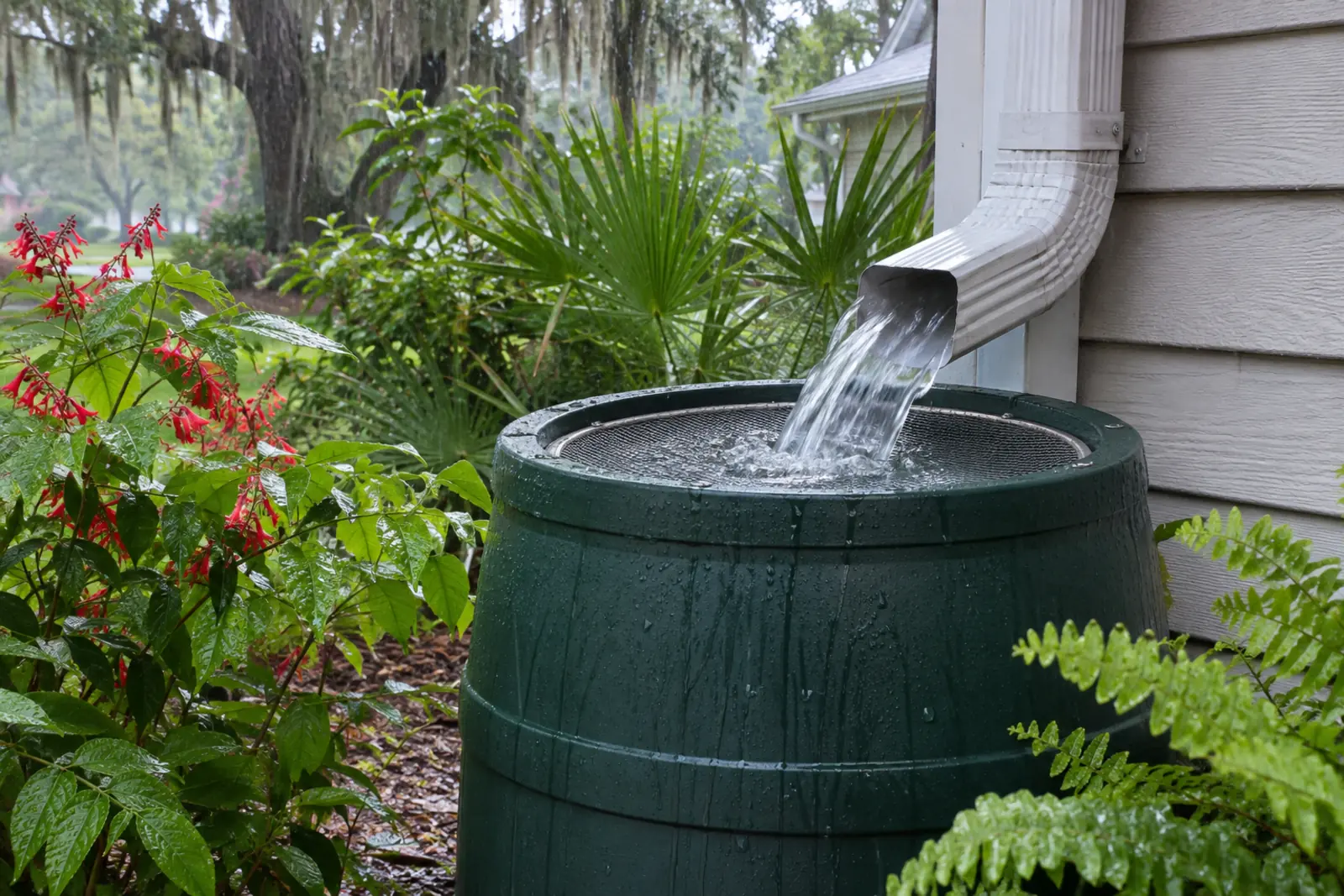
A rain barrel or cistern lets a Florida household catch roof runoff and use it to water ornamental plants, even on days when watering restrictions apply, as long as the container is screened against mosquitoes and the water is treated as untreated runoff, never as drinking water. Neighborhood stormwater ponds are the community-scale version: engineered basins that control flooding and filter pollutants. They are not swimming holes or water supplies.
Rain barrels in Florida: how they work
According to UF/IFAS Gardening Solutions, a rain barrel is generally a 50- to 80-gallon container with a fine screen to keep out leaves and insects and a tap or small pump, usually set under a downspout. Much of Florida's rain falls in summer, and a barrel saves a little of it for drier weeks. The yield adds up fast: for every inch of rain on 1,000 square feet of roof, about 600 gallons can be collected, counting the house footprint plus the eaves. Plan for overflow.
- Use only a food-grade drum, such as one that held juice, olives or pickles, that has never stored chemicals.
- Set it on a stable, level base; a full barrel is heavy.
- Route the overflow away from the foundation and the neighbor's yard, ideally into a planted bed.
- Raise the barrel enough to fit a watering can under the spigot, or connect a seep hose; gravity gives only low pressure.
Many county Extension offices run rain barrel workshops. UF/IFAS's rain barrel page covers construction in more detail.
How much water does a rain barrel actually collect?
Less than most people expect, and it arrives in bursts. UF/IFAS gives 600 gallons per inch of rain on 1,000 square feet of roof, and says 10 to 30 percent of the rain that hits a roof can be lost to evaporation, wind or gutter spillage. A downspout that drains half of a 1,000-square-foot roof therefore delivers roughly 300 gallons per inch of rain before losses, so a single 55-gallon barrel can fill in well under a quarter inch of rain and then overflow.
The practical lessons are the same ones UF/IFAS gives: check the overflow regularly, consider more than one barrel if you want to store more, and treat the barrel as a buffer for a few watering sessions rather than a replacement for irrigation. For a quick estimate, multiply your roof area feeding the downspout (in square feet) by 0.6 gallons for each inch of rain, then subtract the 10 to 30 percent loss.
Free rain barrels and rain barrel programs in Florida
There is no single statewide free rain barrel program. According to UF/IFAS, many county Extension offices offer free rain barrel workshops, and some provide containers to participants for free or a small fee. Availability varies by county and over time, so the reliable first step is to contact your county's UF/IFAS Extension office and ask whether a workshop is scheduled.
Other places worth checking are your water utility's conservation page and your water management district, since some districts publish homeowner guidance on water conservation; UF/IFAS cites the Southwest Florida Water Management District's "Rain Barrels: A Homeowner's Guide" as its source. If no program is running, barrels are sold at garden and home improvement centers, and a food-grade drum can be converted at home using the checklist above. Prices and rebates are not fixed, so confirm any offer with the organization running it.
Keeping mosquitoes out
UF/IFAS says barrels can and should be made mosquito-proof with a tight-fitting lid and mesh screen. Screen every opening, including the inlet and overflow, and check screens after storms for tears or clogs. Use the water regularly so it does not sit for long, and do not leave buckets or saucers of standing water nearby. A UF/IFAS Extension fact sheet adds that Bt (Bacillus thuringiensis israelensis) kills mosquito larvae but is harmless to birds, fish, wildlife and pets; if you use a larvicide dunk, choose a product labeled for the purpose and follow the label.
The Florida Department of Health's mosquito prevention advice for the rest of the yard is to drain containers where rain or sprinkler water collects, such as buckets, flowerpots and pool covers, and to empty and clean birdbaths and pet water bowls at least once or twice a week. A screened barrel is fine; an open, unscreened one is a mosquito breeding site.
What to use rainwater for
Roof runoff picks up whatever is on the roof and in the gutters: dust, leaves, bird droppings and material from roofing. Clear does not mean clean. Because the water does not come from the public supply, UF/IFAS notes you can use it whenever you want, including during watering restrictions, which makes a barrel handy in a drought. Check the watering restrictions if the barrel feeds a system that also uses another source.
UF/IFAS lists hand watering, seep irrigation for planting beds, lawns, ornamentals, orchids, houseplants and ponds or water features as good uses. Rainwater is also soft and free of most calcium, chlorine and lime, so it suits washing cars, tools and windows.
| Use | Do | Don't |
|---|---|---|
| Ornamental beds and containers | Pour at the soil line with a can or seep hose | Leave a hose running onto pavement |
| Vegetables and herbs | Water the soil, not the leaves, and wash produce | Splash roof runoff on produce you eat raw |
| Drinking, cooking, pets' bowls | Use tap water | Use barrel water, even if it looks clear |
| Play, bathing, pools | Use the drinking water supply | Use stored runoff |
For edible plants, UF/IFAS is stricter than the table: it says edibles should not be watered with untreated roof runoff unless the water is treated or purified first. If you are unsure, use tap water on the vegetable bed and keep the barrel for ornamentals. Wash your hands after working with collected water. The same caution about produce eaten raw applies to reclaimed water, as the guide to reclaimed water and vegetable gardens explains. Rainwater from a barrel is also a different thing from reclaimed water, which is treated municipal wastewater; the myths and facts about reclaimed water page covers how that supply is treated and what it is safe for. Neither is drinking water.
Barrel upkeep through the year
- After storms: check screens, the overflow route and the base.
- Before a long absence: UF/IFAS advises disconnecting the downspout and covering the top screen, so heavy rain cannot overflow the barrel and damage the foundation of the house.
- Gutters: keep them clear of leaves, since debris is what reaches the screen and the water.
Cisterns in Florida and bigger systems
A cistern is a large tank, above or below ground, that stores runoff from more roof area and usually needs a pump to deliver it. It needs a firm foundation, secured and screened openings, a way to remove sediment and an overflow route. Storage and a pump do not make the water drinkable. Permits and plumbing codes can apply, especially to permanent piping or anything near building plumbing, so check with your local building department first. Keep any non-potable line clearly separate from the drinking water plumbing; the guide to purple pipes and cross-connections shows why mixing the two is a hazard. Pair any system with the habits in saving water at home.
Neighborhood stormwater ponds: what they are for
UF/IFAS's 2024 publication Frequently Asked Questions about Stormwater Wet Ponds estimates that Florida has at least 76,000 stormwater ponds and possibly as many as 100,000. They are human-made, engineered water bodies. Dry ponds fill during storms and drain into the soil; wet ponds hold water permanently and are often mistaken for natural lakes. Signs of a stormwater pond include concrete or metal overflow structures, pipes, street drains that lead to it, and fountains or other aerators.
Their primary jobs are catching runoff from roofs, lawns and roads to reduce flooding, and filtering out the pollutants that runoff carries; some also recharge groundwater. Many residents do not know that. In a UF/IFAS survey of 2,499 homeowners and HOA board members released on April 28, 2026, only about 28% identified both main functions: 70% knew the ponds control flooding, 37% knew they are supposed to remove pollutants, and 29% thought they were there for looks.
Why ponds are not for swimming or drinking
- They collect pollution by design. Fertilizer, pet waste, decaying plants, reclaimed irrigation water, motor oil, coolant, car wash soap and pesticides all wash in, according to UF/IFAS.
- Algae. Extra nutrients feed algae. Florida Department of Health alerts advise against drinking, swimming or wading where a blue-green algae bloom is visible, and warn that the algae can be present even when no bloom shows.
- Alligators. The Florida Fish and Wildlife Conservation Commission advises swimming only in designated swimming areas during daylight hours, keeping pets leashed and away from the water's edge, and never feeding alligators, which is illegal.
What homeowners and HOAs can do
UF/IFAS recommends using less fertilizer (especially on reclaimed-irrigated lawns), following local fertilizer ordinances, picking up pet waste, keeping grass clippings and leaves out of ponds and storm drains, keeping sprinklers off pavement, pointing downspouts at lawns or beds instead of driveways, covering bare soil, adding rain gardens and planting native plants along the shore to stop erosion. Florida-Friendly Landscaping also recommends a 10-foot-wide low-maintenance buffer around ponds with no mowing or chemical applications. Pump pond water for irrigation only where the HOA and any permit allow it.
On rules: section 373.185 of the Florida Statutes says deed restrictions and covenants may not prohibit Florida-friendly landscaping. That law does not mention rain barrels specifically, and associations may still regulate placement and appearance, so read your documents before installing one.
Frequently Asked Questions
Can I use rain barrel water during watering restrictions?
Generally yes. UF/IFAS notes that rain barrel water does not come from the public water system, so you can use it whenever you want, including during restrictions. Check local rules if the barrel is tied into an irrigation system that also uses another water source.
Are there free rain barrels in Florida?
Sometimes. UF/IFAS says many county Extension offices offer free rain barrel workshops, and some supply containers for free or a small fee. There is no statewide giveaway, so call your county Extension office and check your utility and water management district for current offers.
How do I keep mosquitoes out of a rain barrel?
Fit a tight lid and fine mesh screen over every opening and repair tears promptly. Use the water regularly. A Bt larvicide dunk labeled for the purpose is an option, since UF/IFAS Extension notes Bt kills mosquito larvae but is harmless to birds, fish, wildlife and pets.
How much water will a rain barrel hold, and how fast does it fill?
Typical barrels hold 50 to 80 gallons. UF/IFAS puts roof yield at about 600 gallons per inch of rain on 1,000 square feet, so one downspout can fill a barrel in a single shower and then overflow. Direct the overflow away from the foundation.
Is rain barrel water safe for vegetables?
Roof runoff is untreated. UF/IFAS says edible plants should not be watered with untreated roof runoff unless the water is treated or purified. Use tap water on vegetables, or at minimum pour on the soil rather than the leaves and wash produce and hands with tap water. Never drink it or use it for cooking.
Can I swim in my neighborhood stormwater pond?
No. Stormwater ponds collect runoff pollution by design, can grow blue-green algae and may have alligators. FWC advises swimming only in designated swimming areas during daylight hours.