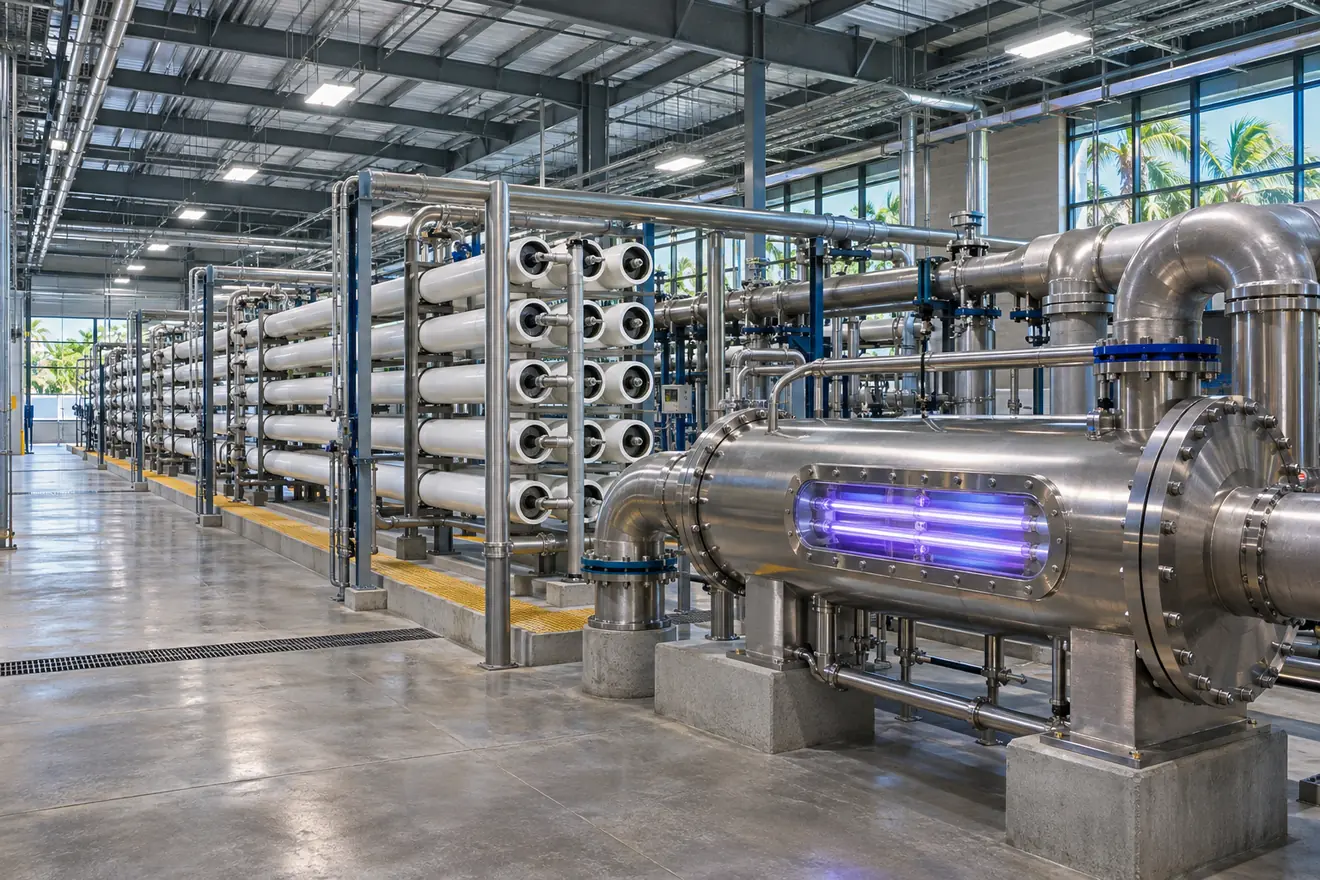
Potable reuse means adding advanced treated water made from municipal wastewater to a drinking water supply. It is a different thing from the reclaimed water in purple irrigation pipes, which is not drinking water. Florida regulates potable reuse under Chapter 62-565 of the Florida Administrative Code, which took effect on Feb. 26, 2025 and sets requirements for direct and indirect potable reuse and for the Advanced Treatment Water Facilities that produce the water. In short, indirect potable reuse sends the treated water through an aquifer, lake or river before it is drawn for drinking water treatment, while direct potable reuse sends it to the intake of a drinking water plant or straight into the distribution system, with no environmental buffer in between.
Potable reuse in plain terms
Water can be treated and used again for many purposes, and the level of treatment follows the use. Reclaimed water for lawns and parks receives secondary treatment, filtration and high-level disinfection; its pipes are purple and its outlets say "do not drink." That is enough for irrigation, not for drinking. The guide to what reclaimed water is covers that familiar kind of reuse.
FDEP's potable reuse FAQ defines potable reuse as "the augmentation of a drinking water supply with advanced treated water from a municipal wastewater source." It is a separate, permitted process with additional treatment barriers, its own monitoring and licensed operators. It never means connecting an irrigation line to household plumbing.
The U.S. EPA's water reuse page says the national picture is already well established: more than 70 drinking water reuse projects serve over 8 million people per day, and Orange County, California produces up to 100 million gallons per day of recycled water to supply drinking water. EPA also notes that states generally hold primary regulatory authority over water resources, which is why potable reuse rules such as Florida's are written at the state level.
Indirect vs. direct potable reuse
FDEP distinguishes the two by where the advanced treated water goes before it becomes part of the drinking water supply. "Direct" describes the route; it does not mean wastewater reaches a tap without treatment.
| Type | Where the treated water goes | Key feature |
|---|---|---|
| Indirect potable reuse (IPR) | Planned delivery or discharge to groundwater or surface water to develop or supplement a potable supply | An environmental buffer (an aquifer, lake or river) sits between treatment and the drinking water plant |
| Direct potable reuse (DPR) | Into a raw water supply immediately upstream of a drinking water treatment facility, or directly into a potable distribution system | No environmental buffer, so treatment and monitoring carry the full load |
In indirect reuse the receiving water body adds time and dilution before water is withdrawn for drinking water treatment, but the buffer is one barrier among several, not a substitute for treatment. FDEP's 2025 Reuse Inventory, published in August 2026, groups "groundwater recharge and indirect potable reuse" together as about 11% of the roughly 1,029 million gallons per day of reclaimed water reused in 2025. For how these routes connect to the state's aquifers and rivers, see where Florida's water comes from.
How Florida got a potable reuse rule
The Florida Potable Reuse Commission describes itself as a coalition of water resource, industry, agricultural, environmental and health professionals, formed by water industry groups to build a consensus framework for potable reuse. Its report, "Framework for the Implementation of Potable Reuse in Florida," is dated January 2020, and state law refers to it as the commission's 2020 report "Advancing Potable Reuse in Florida." It became the basis for the state rules.
The 2020 Florida Clean Waterways Act directed FDEP to start rule revisions based on that report by Dec. 31, 2020. The act says potable reuse rules must address contaminants of emerging concern and meet or exceed federal and state drinking water standards, and it deems reclaimed water a water source for public water supply systems. Florida's Environmental Regulation Commission approved the rules at a hearing on Dec. 13, 2024. They were published in the Florida Administrative Register (Vol. 51, No. 28, Feb. 11, 2025) and took effect on Feb. 26, 2025, citing section 403.064(17), Florida Statutes, among their sources of authority. The full text is in the official Chapter 62-565.
What Chapter 62-565 requires
FDEP describes the approach as multiple layers of protection: source control, treatment built for resiliency (the ability to adjust to upsets), redundancy (backup systems) and robustness (processes that address several contaminants at once), plus expanded monitoring and reporting for pathogens and emerging constituents, which it describes as pharmaceuticals, personal care products and other unregulated chemicals.
| Requirement | What the rule asks for |
|---|---|
| Pathogen reduction (Rule 62-565.530) | At least 12-log removal of Giardia cysts, 12-log of Cryptosporidium oocysts and 14-log of enteric viruses from raw wastewater to finished water |
| Risk goal | Combined annual risk of acute gastrointestinal illness kept below 1 in 10,000 |
| Critical control points | At least three separate points for pathogen reduction, including one disinfection point and one filtration point |
| Pathogen monitoring (Rule 62-565.540) | Giardia, Cryptosporidium and enteric viruses monthly at influent and effluent; total coliform and E. coli daily |
| Chemical monitoring | Total organic carbon daily; six PFAS (PFOA, PFOS, PFHxS, PFNA, HFPO-DA and PFBS) quarterly at influent and effluent |
| Operators | Licensed operators on site and responsible for the facility at all times |
| Direct connection to distribution | Must also meet the state drinking water rules in Chapters 62-550 and 62-555 |
A "log" is a factor of ten. A 12-log reduction cuts the number of organisms by a factor of one trillion, and a 14-log reduction by a factor of one hundred trillion. These are performance requirements for treatment, not a promise that risk is zero, which is why the rule pairs them with monitoring and multiple control points.
How Chapter 62-565 is organized
The official chapter listing on the Florida Administrative Rules site shows 28 rules, all with a latest effective date of Feb. 26, 2025. Beyond the pathogen and monitoring rules above, the chapter covers the parts of a project that tend to decide whether it can be built:
- Requirements for potable reuse systems (62-565.500) and industrial pretreatment (62-565.505), which deal with the system as a whole and with keeping problem discharges out of the sewer.
- Aquifer storage and recovery (62-565.510), for ASR systems associated with potable reuse, and off-spec storage (62-565.520), for holding water that does not meet specifications at an Advanced Treatment Water Facility.
- Reporting (62-565.550), the pilot testing program (62-565.560) and the engineering report (62-565.570).
- Design, construction, operation and maintenance (62-565.580 and 62-565.590).
- Permitting, from the application procedure (62-565.600) and standards for issuing or denying permits (62-565.605) through renewals, transfer, suspension and revocation, public notice (62-565.640) and public comment and public meetings (62-565.645).
- Compliance for Advanced Treatment Water Facilities and potable reuse systems (62-565.700).
The chapter's public notice and public comment provisions mean the permitting process includes a way for the public to weigh in.
How a project moves from idea to tap
According to FDEP's FAQ, potable reuse is not mandatory for utilities. A utility that wants to pursue it has to demonstrate, step by step, that its particular source water and treatment train will work. In general terms:
- Define the supply route (indirect or direct) and the treatment approach.
- Put enhanced pretreatment and source control in place to limit problem discharges into the sewer system.
- Run the required pilot testing to show the treatment reliably meets the standards.
- Show technical, managerial and financial capability for long-term compliance.
- Obtain permits and set up operating, monitoring and reporting systems.
- Carry out community outreach and education.
A pilot plant is a test, not permission to start delivering drinking water. If your utility proposes a project, its public materials should explain the route, the barriers, the monitoring and the approval status; confirm details with the utility and FDEP.
What treated potable reuse water is like
Advanced treatment relies on several processes in sequence. EPA explains that filters remove germs by size, that chlorine, ultraviolet radiation or ozone can destroy them, and that advanced membrane and filter processes remove regulated and unregulated chemicals, with multiple processes providing redundancy. Because the water is so thoroughly purified, EPA adds that it may need salts and minerals added back after treatment to improve the taste, and its pH may be adjusted to limit pipe corrosion.
What it means for households today
For most Floridians nothing changes at the tap until a permitted project is built in their area. The purple-pipe water in yards remains irrigation water under a different chapter of rules, and it should never be drunk; the guide to purple pipes and cross-connections explains how that water is kept separate from household plumbing, and the page on using reclaimed water on a vegetable garden covers a common irrigation question. Questions about safety, PFAS and treatment upsets are reasonable; the page on reclaimed water myths and facts addresses several of them, and the guide to alternative water supplies shows where potable reuse fits alongside desalination and storage.
Frequently Asked Questions
Does direct potable reuse skip treatment?
No. Direct potable reuse sends advanced treated water to a point just upstream of a drinking water plant or into a potable distribution system. The word direct describes the route, not a lack of treatment.
When did Florida's potable reuse rule take effect?
Chapter 62-565 of the Florida Administrative Code took effect on Feb. 26, 2025. It grew out of the Potable Reuse Commission's 2020 framework report and the 2020 Clean Waterways Act.
Are utilities required to adopt potable reuse?
No. FDEP states that potable reuse is not mandatory for utilities. A utility that chooses it must meet the pilot testing, permitting, monitoring, operator and outreach requirements.
Does Florida's rule monitor PFAS in potable reuse water?
Yes. Rule 62-565.540 requires quarterly monitoring of six PFAS compounds, PFOA, PFOS, PFHxS, PFNA, HFPO-DA and PFBS, at the influent and effluent of Advanced Treatment Water Facilities.
What is the difference between indirect and direct potable reuse?
Indirect potable reuse places advanced treated water in groundwater or surface water first, so an aquifer, lake or river sits between the treatment plant and the drinking water plant. Direct potable reuse has no such buffer: the water goes immediately upstream of a drinking water treatment facility or directly into the distribution system. Both are governed by Chapter 62-565.
Is potable reuse the same as reclaimed water?
No. Reclaimed water from purple pipes is treated for irrigation and similar uses and must not be drunk. Potable reuse water goes through additional treatment barriers and monitoring under a separate permitted process before it can join a drinking water supply.
Can the public comment on a potable reuse project?
The chapter includes rules on public notice (62-565.640) and on public comments and requests for public meetings (62-565.645), and FDEP lists community outreach and education among the steps a utility should take. Check the utility's and FDEP's notices for the details of a specific project.