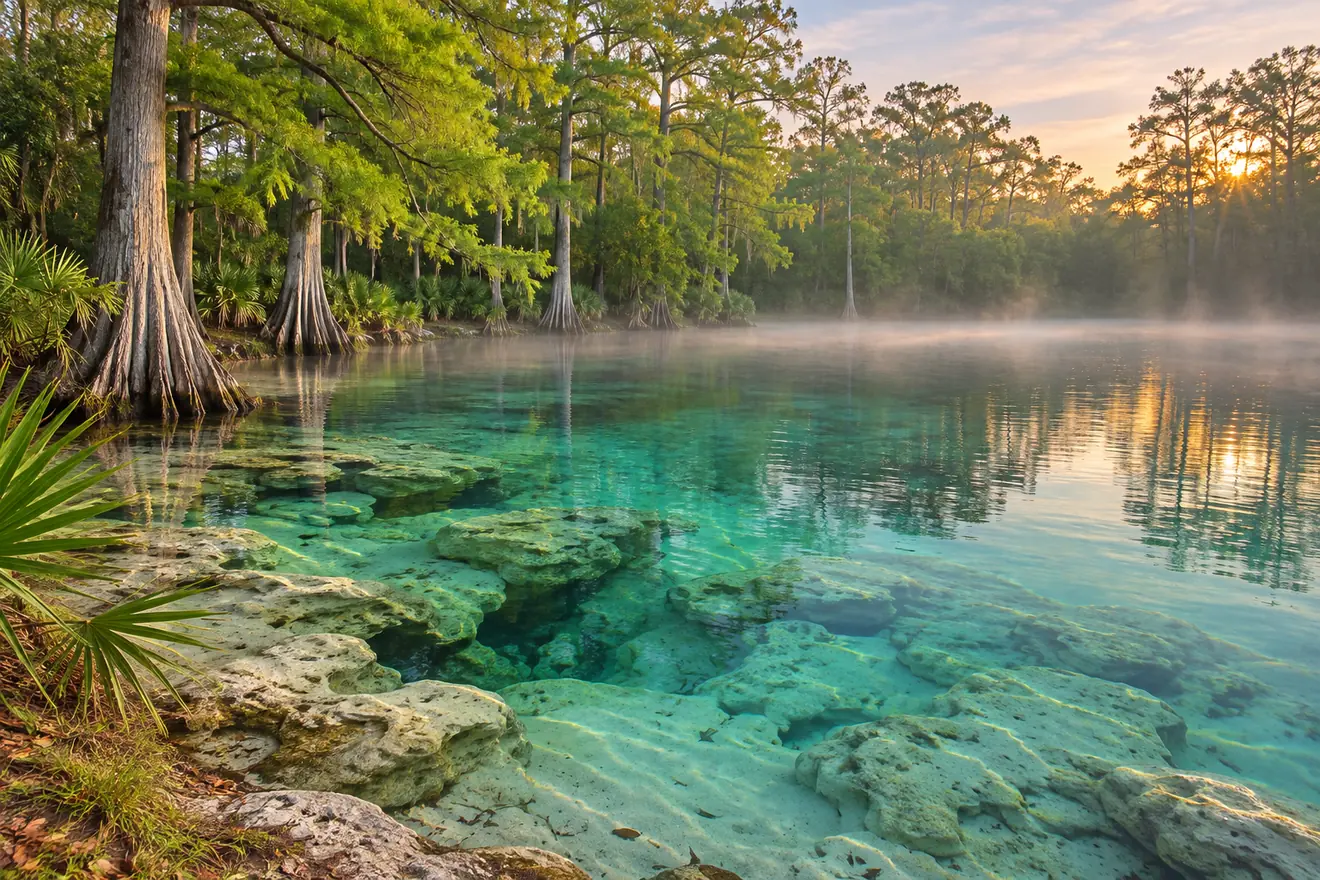
Florida's water comes mainly from the Florida aquifer system: the Floridan aquifer system, which underlies the whole state, and the shallow Biscayne aquifer in the southeast, plus springs, rivers, lakes and reservoirs. According to the U.S. Geological Survey, groundwater supplied drinking water to 92% of Florida's population in 2015, most of it pumped from the Floridan aquifer system, with the shallow Biscayne aquifer serving southeast Florida. Rivers, lakes, canals and reservoirs supply the rest of the drinking water and much of the farm irrigation, and reclaimed water now covers a large share of lawn watering. Growth, saltwater intrusion and declining spring flows are the main pressures on that supply.
The Floridan aquifer system
An aquifer is a layer of rock or sediment that stores water in its pores and openings and lets it move to wells and springs. The Floridan is mostly limestone and dolomite, rock that slowly dissolves and develops connected openings, which is why it yields so much water. The USGS Floridan aquifer study calls it "one of the most productive aquifers in the world." It covers about 100,000 square miles under all of Florida and parts of Georgia, Alabama, Mississippi and South Carolina, and it is the primary source of drinking water for almost 10 million people. Agricultural irrigation accounts for nearly 50 percent of all withdrawals from it.
Its water is not fresh everywhere. In south Florida, USGS notes, the Upper Floridan is brackish and is used as source water for reverse osmosis plants, for blending with fresh Biscayne aquifer water and for aquifer storage and recovery, while the deeper Lower Floridan there is saline and is used to dispose of treated wastewater effluent.
Where the Floridan aquifer is and how it is layered
The Floridan aquifer system is not one uniform tank. It has two main parts, the Upper Floridan and the Lower Floridan, separated by sediments whose permeability varies from place to place. The Upper Floridan is the main source of the water withdrawn from the system. The Lower Floridan is generally less permeable, and its water can be highly mineralized or saline, though it is relatively fresh in central Florida.
How the aquifer behaves depends on whether clay lies on top of it:
- Unconfined areas. In west-central and northern Florida, and along its updip margin, limestone reaches or lies near the surface. Rain and surface water can move down into the aquifer there more readily than where clay caps it.
- Confined areas. Where a thick confining layer covers it, as in South Florida, the aquifer is more insulated from the surface.
- Thickness. The system is less than 100 feet thick at its updip edge and more than 3,700 feet thick in southwestern Florida.
Using a Florida aquifer map
A Florida aquifer map usually shows two things: the footprint of the Floridan aquifer system, which covers the entire peninsula and Panhandle, and the small southeastern area where the Biscayne aquifer is the main source. Better maps also shade confined and unconfined areas, which matters more for protecting water quality than the outline alone. USGS and the water management districts publish aquifer and groundwater-level maps for their regions, and your utility's annual water quality report names the source it draws from.
The Biscayne and other shallow aquifers
The Biscayne aquifer is a shallow, highly permeable limestone aquifer under southeast Florida. EPA designated it a sole source aquifer in 1979 for Broward, Miami-Dade, Monroe and Palm Beach counties; under EPA's definition, a sole source aquifer supplies at least 50 percent of the drinking water consumed in the area above it. Because it lies so close to the surface, rain recharges it quickly, and pollution and seawater can reach it quickly too.
Elsewhere, shallow surficial aquifers in sand and shell supply some local wells, including irrigation wells. Their yield and quality vary widely, and well construction is regulated by the water management districts.
Springs: windows into the aquifer
A spring is groundwater flowing out at the surface, so its health mirrors the aquifer's. FDEP notes that Florida has more large (first- and second-magnitude) springs than any other state. Spring flows drop when aquifer levels decline, and excess nutrients, mainly nitrate, feed algae. In 2016 the Legislature named 30 Outstanding Florida Springs for additional protection. Clear spring water can still carry too much nitrate, so appearance says little about the aquifer's condition.
Rivers, lakes and reservoirs
Surface water matters most where groundwater is limited or brackish and where large rivers or lakes are close to demand. In 2015, according to USGS, the Southern Florida subregion, which includes Lake Okeechobee and the canals of the Everglades Agricultural Area, accounted for 52% of the state's fresh surface-water withdrawals.
Reservoirs bridge wet and dry seasons. Tampa Bay Water stores surface water in the 15.5-billion-gallon C.W. Bill Young Regional Reservoir during wet periods and draws on it in dry ones. During the 2025-2026 drought, SWFWMD reported the reservoir held 7.87 billion gallons on Sept. 20, 2026, about half its capacity. Groundwater and surface water are also linked: aquifers feed many rivers through springs and seepage, and pumping can reduce those flows.
Who uses Florida's water
The most recent statewide USGS water-use report, Scientific Investigations Report 2019-5147, published in 2020, covers 2015 data. Withdrawals are amounts taken from a source, not amounts permanently used up.
| Measure (2015, USGS) | Figure |
|---|---|
| Total withdrawals, fresh and saline | 15,319 million gallons per day, of which saline water was 63% |
| Freshwater withdrawals | 5,721 million gallons per day: groundwater 63%, surface water 37% |
| Groundwater from the Floridan aquifer system | Almost 62% of groundwater withdrawals |
| Drinking water from groundwater | 18.324 million people, 92% of the population |
| Drinking water from fresh surface water | 1.491 million people, 8% of the population |
| Largest freshwater users | Public supply 39%, agricultural self-supply 37% |
The balance is shifting. FDEP notes that surface water was Florida's largest freshwater source until 1980, when groundwater took over. Based on the water management districts' regional plans, FDEP projects population growth of 23% (4.8 million people) to 26.4 million between 2020 and 2040, and water demand growth of 13% (866 million gallons per day) to 7,302 million gallons per day, with public supply passing agriculture as the largest user.
Pressures on the supply
- Growth. More homes mean more drinking water and more lawns to irrigate.
- Saltwater intrusion. Along the coasts, heavy pumping can let salty water move toward freshwater wells.
- Springs, lakes and wetlands. Lower aquifer levels reduce spring flows and can lower lakes and dry wetlands.
- Nutrients. Nitrate from sources such as wastewater, stormwater and fertilizer can travel through the aquifer to springs, which is why FDEP funds wastewater and stormwater projects in spring areas.
- Drought. The 2025-2026 drought pushed several districts into water shortage orders that limited lawn watering to one day a week.
FDEP concludes that groundwater withdrawals are expected to level off as the source reaches its sustainable limit, and that meeting all future demand from groundwater in large areas would cause unacceptable impacts, including saltwater intrusion, reduced spring flows, lowered lake levels and loss of wetlands. The water management districts plan supply region by region with that limit in mind.
Where reuse and conservation fit
Conservation shrinks demand, and reuse replaces drinking-quality water where it is not needed. Reclaimed water's safety and its smell and salt content are covered in the guide to reclaimed water myths and facts, and highly treated water can also be returned to supplies, as described in the guide to potable reuse in Florida. FDEP's 2025 Reuse Inventory, published in August 2026, reports about 1,029 million gallons per day of reclaimed water reused in 2025 and estimates that reuse added about 119 billion gallons a year back to available supplies. The next tier, explained in the guide to alternative water supplies, includes desalination, storage and potable reuse. Lawn watering is the most visible link between households and the aquifer, so lawn watering restrictions are worth checking, and those with reclaimed water service can read about using reclaimed water on a vegetable garden. At home, the steps in saving water at home and using reclaimed water wisely make the biggest difference.
Frequently Asked Questions
Where does Florida's tap water come from?
Mostly from underground. USGS found that groundwater supplied drinking water to 92% of Floridians in 2015, largely from the Floridan aquifer system, with the Biscayne aquifer serving southeast Florida. Some utilities use rivers, lakes, reservoirs or desalinated water, and your utility's website lists its sources.
Where is the Floridan aquifer located?
The Floridan aquifer system underlies all of Florida and parts of Georgia, Alabama, Mississippi and South Carolina, about 100,000 square miles in all. It is unconfined in west-central and northern Florida and thickly confined in South Florida, so the same aquifer behaves differently from one region to another.
How deep and thick is the Floridan aquifer?
Thickness varies widely: less than 100 feet at its updip margin and more than 3,700 feet in southwestern Florida, according to the USGS hydrogeologic framework. The Upper Floridan is the shallower part and supplies most of the water that is pumped.
Is the Floridan aquifer an underground lake?
No. It is water-bearing limestone and dolomite with connected pores, fractures and dissolved openings. Some cavities are large, but water moves through the rock rather than sitting in one open lake.
How many people rely on the Floridan aquifer?
USGS describes the Floridan aquifer system as the primary source of drinking water for almost 10 million people across Florida and parts of neighboring states. It underlies about 100,000 square miles.
Why is some Florida groundwater salty?
Salinity depends on depth, geology and nearness to the sea. In south Florida the Upper Floridan aquifer is naturally brackish, and heavy pumping near the coast can pull seawater toward wells. Brackish water needs desalination before it can be used for drinking.
Is Florida running out of groundwater?
FDEP expects groundwater withdrawals to level off as the source reaches its sustainable limit. Pumping more in many areas would harm springs, lakes and wetlands and raise saltwater intrusion, so new demand is shifting to conservation, reuse and alternative supplies.