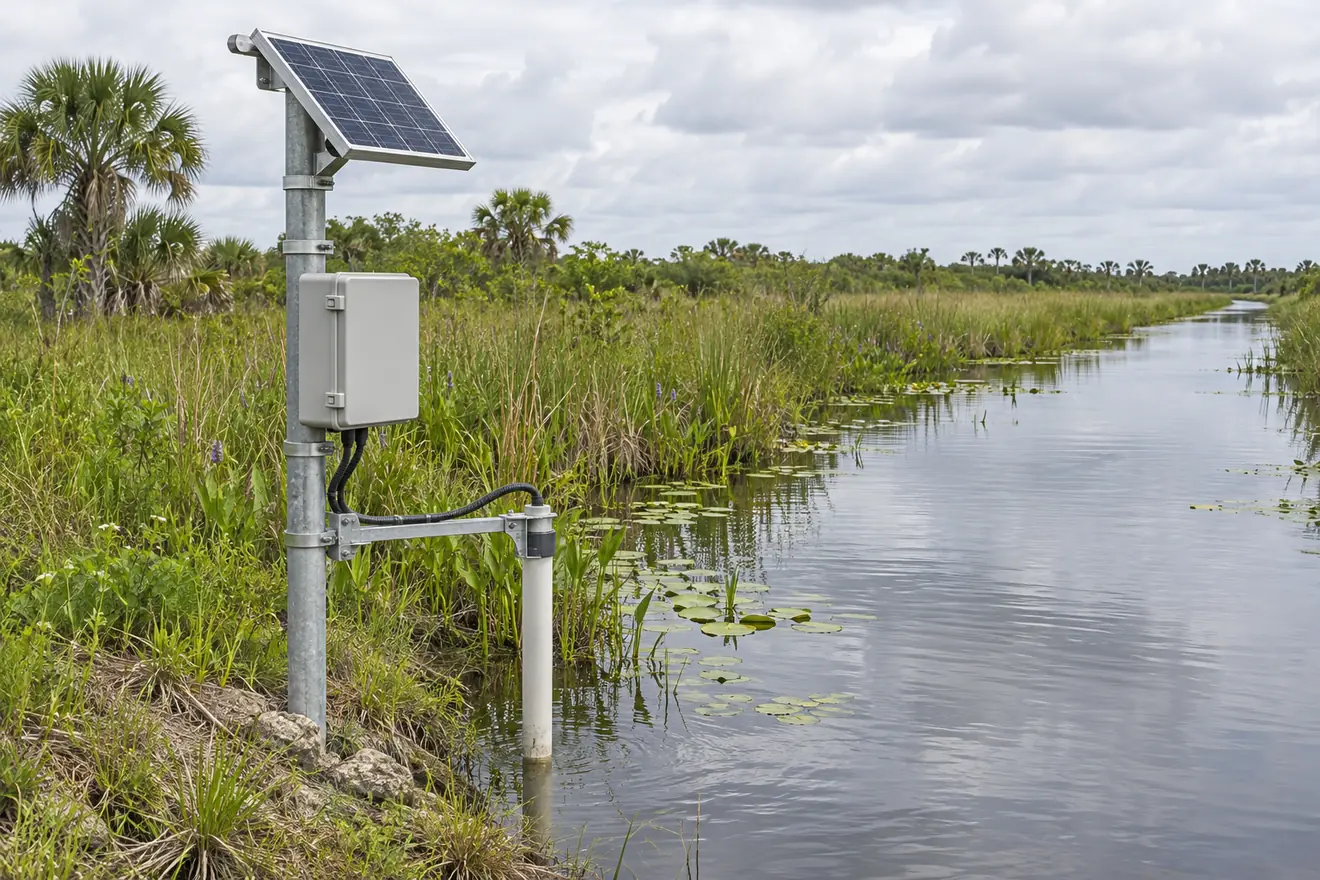
Florida is divided into five water management districts: Northwest Florida, Suwannee River, St. Johns River, Southwest Florida and South Florida. They are regional agencies that manage water supply, water quality, flood protection and natural systems; they issue water use, well and environmental resource permits, set lawn watering rules and declare water shortages. FDEP supervises them, utilities deliver the water to your tap, and cities and counties add local rules on top.
The five districts at a glance
District lines are drawn largely along natural drainage basins rather than county lines, so some counties are split between two districts. Headquarters cities are from FDEP's 2025 Reuse Inventory; areas are from the districts' own descriptions.
| District | Headquarters | General area |
|---|---|---|
| Northwest Florida (NWFWMD) | Havana | The western Panhandle, from Escambia County east to the Tallahassee area |
| Suwannee River (SRWMD) | Live Oak | 15 counties in north-central Florida, nine entirely and six in part |
| St. Johns River (SJRWMD) | Palatka | 18 counties in northeast and east-central Florida, about 12,283 square miles |
| Southwest Florida (SWFWMD) | Brooksville | 16 counties in west-central Florida, all or in part, including the Tampa Bay area |
| South Florida (SFWMD) | West Palm Beach | 16 counties from Orlando to the Florida Keys, serving about 9 million residents |
Water management district boundaries: which counties are in each district
FDEP publishes a map of the five district regions and a county list for each district. Counties in the first column of the table below sit entirely inside one district; the second column lists counties that are only partly in the district, so the district's boundary map decides which side of the line a property is on.
| District | Counties entirely in the district | Counties only partly in the district |
|---|---|---|
| Northwest Florida | Bay, Calhoun, Escambia, Franklin, Gadsden, Gulf, Holmes, Jackson, Leon, Liberty, Okaloosa, Santa Rosa, Wakulla, Walton, Washington | Jefferson (western half) |
| Suwannee River | Columbia, Dixie, Gilchrist, Hamilton, Lafayette, Madison, Suwannee, Taylor, Union | Alachua, Baker, Bradford, Jefferson, Levy |
| St. Johns River | Brevard, Clay, Duval, Flagler, Indian River, Nassau, Seminole, St. Johns, Volusia | Alachua, Baker, Bradford, Lake, Marion, Okeechobee, Orange, Osceola, Putnam |
| Southwest Florida | Citrus, DeSoto, Hardee, Hernando, Hillsborough, Manatee, Pasco, Pinellas, Sarasota, Sumter | Charlotte, Highlands, Lake, Levy, Marion, Polk |
| South Florida | Broward, Collier, Glades, Hendry, Lee, Martin, Miami-Dade, Monroe, Palm Beach, St. Lucie | Charlotte, Highlands, Okeechobee, Orange, Osceola, Polk |
Source: FDEP's water management district page, which lists Miami-Dade as "Dade." Orange, Osceola and Polk show why the county alone is not enough: FDEP lists each in two districts (St. Johns River and South Florida for Orange and Osceola; Southwest Florida and South Florida for Polk), so the answer depends on where the property sits.
Where the districts came from
Chapter 373 of the Florida Statutes is titled the "Florida Water Resources Act of 1972." Section 373.069 divides the state into the five districts "at 11:59 p.m. on December 31, 1976," and SJRWMD describes the five as established by the Legislature in 1972. Two districts have older roots in flood control: SFWMD traces its history to 1949, and SWFWMD was created in 1961 by a special act of the Legislature to sponsor a federal flood control project after Hurricane Donna struck in 1960.
The idea behind the system is that water does not stop at city or county lines. FDEP's summary puts it simply: "It is a policy of the Legislature that the state's water resources be managed at a state and regional level." A large wellfield in one county can lower lakes or spring flows in another, and flood control works the same way.
What the districts do
FDEP lists four core mission areas for the districts: water supply, water quality, flood protection and floodplain management, and natural systems. In practice that means:
- Water supply planning. Under section 373.709, regional water supply plans must cover at least a 20-year planning period and list traditional and alternative water supply projects that are technically and financially feasible.
- Minimum flows and levels. Districts set limits meant to protect rivers, springs, lakes and aquifers from significant harm caused by withdrawals.
- Watering rules and shortages. Year-round landscape irrigation rules, such as Chapter 40E-24 in South Florida, Rule 40D-22.201 in Southwest Florida and Rule 40C-2.042 in St. Johns River, plus temporary water shortage orders. In 2026, for example, SWFWMD extended Modified Phase III restrictions through March 31, 2027, and SJRWMD declared a Phase III shortage on May 11, 2026.
- Flood control and land. Canals, structures and conservation lands, especially in the two districts that began as flood control agencies.
The schedules themselves are explained in the guide to lawn watering restrictions.
Water management district permits: which one do you need?
Florida's districts handle three main permit types. A water use permit (also called a consumptive use permit) allows withdrawal of a specified amount of water from the ground, a lake or a river. A well construction permit is required before a water well is installed. An environmental resource permit covers stormwater management and work that affects wetlands and surface waters. Southwest Florida's district describes the water use and well construction permits on its permits page; rules and procedures differ by district.
- Water use permit: large withdrawals by utilities, farms, golf courses and industry.
- Well construction permit: new water wells, before installation.
- Environmental resource permit: drainage, stormwater systems, filling or work that affects wetlands.
Whether a particular household project needs a permit depends on the district and the size of the work, so ask the district's regulatory staff before you start rather than assuming an exemption applies.
Permits that affect homeowners and utilities
District programs cover the consumptive use of water, well construction and environmental resource permitting. A consumptive use permit (often called a water use permit) authorizes large withdrawals by utilities, farms, golf courses and industry. Under section 373.223, an applicant must show that the use is a "reasonable-beneficial use," "will not interfere with any presently existing legal use of water," and "is consistent with the public interest."
Homeowners meet the districts mostly through well permits, watering rules and environmental resource permits for drainage, stormwater and work affecting wetlands. Utilities, by contrast, hold the big water use permits for their wellfields and plants, which is one reason regional plans push them toward reuse and the alternative water supplies described elsewhere in this guide.
How the pieces fit together
FDEP "exercises general supervisory authority over the state's five water management districts." Each district is run by a governing board: under section 373.073, boards have 9 members who live in the district (Southwest Florida has 13), appointed by the Governor and confirmed by the Senate for 4-year terms. Under section 373.503, districts may levy property taxes up to a capped millage rate set in statute for each district, ranging from 0.05 mill in Northwest Florida to 1.0 mill in Southwest Florida.
| Organization | Main role | When a homeowner deals with it |
|---|---|---|
| FDEP | Statewide rules (including reuse and potable reuse), oversight of the districts | Rarely directly; its rules shape what utilities may do |
| Water management district | Regional resource management, permits, watering rules, shortage orders | Well permits, watering schedules, drainage or wetland work |
| City or county | Local ordinances, often stricter, and enforcement | Local watering days, fines, fertilizer ordinances |
| Utility | Holds water use permits, treats and delivers water, runs reclaimed systems | Service, billing, pressure, reclaimed availability, cross-connection inspections |
If your question is about reclaimed water service, low pressure or a bill, start with the utility; the district does not handle household service problems. Practical yard advice is in the guide to watering with reclaimed water, and the bigger supply picture is in where Florida's water comes from. The state rules that districts and utilities work within for drinking-water reuse are summarized in potable reuse in Florida, and ways to cut your own use are in saving water at home.
Finding your district
Start with FDEP's water management district page, which lists the counties in each district and shows the map of the five regions, then confirm on the district's own boundary map, since some counties are split. Your city or county website usually says which district's watering rules apply. Before drilling a well, changing drainage or planning a large irrigation system, ask the district about permits first.
Frequently Asked Questions
How do I find out which water management district I am in?
Check FDEP's water management district page, which lists counties by district, and confirm on the district's boundary map because some counties are split. Your city or county website usually names the district whose watering rules apply.
Is a water management district the same as a water utility?
No. A district manages regional water resources, permits and watering rules. A utility treats and delivers water, bills customers and runs any reclaimed water system, under permits from the district and FDEP.
Who sets my lawn watering days?
The district's year-round rule and any water shortage order set the baseline, and cities, counties and utilities can add stricter rules. Reclaimed water customers should also follow their utility's schedule.
Who appoints water management district board members?
The Governor appoints them, subject to Senate confirmation, for 4-year terms. Each board has 9 members who live in the district, except Southwest Florida's, which has 13.
How are water management districts funded?
Property taxes are a major source. Section 373.503 of the Florida Statutes lets each district levy ad valorem taxes up to a maximum millage rate set for that district, from 0.05 mill in Northwest Florida to 1.0 mill in Southwest Florida. Districts also receive state and other funding, and the mix differs from district to district.
Which Florida counties are split between two water management districts?
According to FDEP's county lists, Alachua, Baker, Bradford, Charlotte, Highlands, Jefferson, Lake, Levy, Marion, Okeechobee, Orange, Osceola and Polk each appear in more than one district. For those counties, use the district's boundary map to see which district covers your address.
What permits do Florida's water management districts issue?
The main ones are water use permits for withdrawals, well construction permits before a well is installed, and environmental resource permits for stormwater and wetland-related work. Each district publishes its own application process, so check the district that covers your address.